
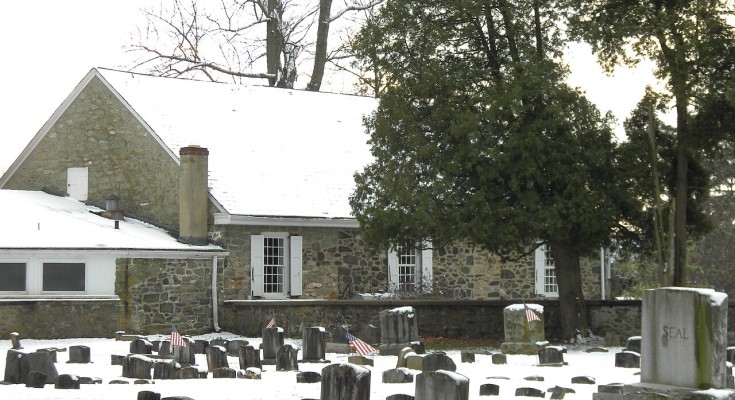
The fields around Birmingham Township look deceptively peaceful in the early morning light. Mist rises slowly above the rolling hills near the Birmingham Friends Meetinghouse, while horses move quietly behind split-rail fences and the distant sound of traffic from Route 202 barely reaches the narrow back roads winding through Dilworthtown and Chadds Ford. Along Birmingham Road, sycamores lean over old stone walls built generations ago, their shadows stretching across the same ground where soldiers once marched through smoke, mud, and gunfire during one of the largest battles ever fought on North American soil.
The landscape carries its history gently here.
A cyclist coasts past the meetinghouse cemetery just after sunrise, slowing almost instinctively near rows of weathered grave markers. Farther down the road, gardeners work outside restored stone homes while commuters disappear quietly into driveways tucked behind long tree-lined lanes. The township feels unmistakably affluent—carefully preserved homes, immaculate properties, winding rural roads—but beneath that polished calm sits something older and more fragile: one of the most intact Revolutionary War landscapes remaining in the United States.
Birmingham Township remains one of the rare places where historic preservation and modern affluence coexist without overwhelming the landscape’s character. As development pressures continue reshaping southeastern Pennsylvania, the township has managed to retain not only its historic buildings, but the surrounding landscape that gives those places meaning. Here, battlefield topography still reads clearly across the hills. Colonial roads still follow their original alignments. Stone houses tied to the Battle of Brandywine remain woven into everyday residential life rather than isolated behind museum gates.
“You can still see the battle if you know where to look,” one local preservation volunteer says quietly while standing near the Birmingham Friends burial ground. “That’s what makes this place different.”
The Battle of Brandywine unfolded across these hills on September 11, 1777, when more than 30,000 British and Continental troops collided in what became the largest land battle fought in North America during the Revolutionary War. British forces under General William Howe executed a flanking maneuver through Birmingham Township that ultimately forced George Washington’s army into retreat, opening the path toward Philadelphia.
But unlike many battlefields later consumed by urban growth, Birmingham’s terrain survived.
The ridgelines remain open. The road network still follows its colonial-era patterns. The meetinghouse where wounded soldiers were treated still stands in remarkable silence above the surrounding fields.
“The first time you walk through the cemetery, it hits you,” the volunteer says. “American soldiers, British soldiers, Quaker families—they’re all buried within sight of each other.”
That layering of histories defines much of the township.
Founded in the late 17th century, Birmingham is one of the oldest townships in Chester County, shaped first by Quaker settlement patterns that emphasized agriculture, simplicity, and dispersed rural communities. Many of the township’s most significant historic structures remain tied to those early Quaker families—particularly the Brintons, whose homes, mills, and farmland still anchor the Brandywine landscape centuries later.
At the George Brinton House, fieldstone walls glow warm gold in late-afternoon light while the surrounding hills roll outward toward the old battlefield corridors. Nearby, the Edward Brinton House and Sharpless Homestead preserve the restrained elegance of Chester County’s colonial vernacular architecture: thick masonry walls, balanced façades, deep fireplaces, and carefully proportioned farmsteads built to endure.
And endure they have.
Much of Birmingham Township today feels intentionally resistant to the pace surrounding it. The township’s population remains relatively small and remarkably stable, shaped by low-density zoning, preserved farmland, and conservation priorities tied closely to the Brandywine Valley’s historic character.
Driving through Dilworthtown, the effect becomes almost cinematic.
Stone buildings cluster quietly around crossroads that once served travelers moving between Philadelphia and the interior countryside. The Dilworthtown Inn still anchors the village with its deeply rooted colonial presence while surrounding structures—old stores, homes, and meeting spaces—retain the scale and texture of the 18th century.
“It doesn’t feel recreated,” says the volunteer while gesturing toward the village center. “That’s the important part. People still live here. Life kept happening.”
Even the township’s wealth often expresses itself through preservation rather than reinvention.
Large homes sit tucked behind preserved tree lines. Historic properties remain carefully maintained rather than dramatically altered. Conservation easements and open-space protections have helped preserve sweeping viewsheds across the Brandywine Valley, where fields, woodlots, and creek corridors still dominate the visual landscape.
That balance between affluence and restraint may be part of Birmingham Township’s unusual atmosphere. Despite its proximity to major suburban corridors, much of the township remains visually quiet.
“There’s a kind of discipline to this place,” the volunteer says with a small smile. “People understand they’re temporary caretakers.”
The township’s historical identity extends beyond the Revolution itself. Along wooded hollows and creek crossings, sites like Brinton’s Mill and Lenape Bridge preserve traces of the agricultural and industrial systems that shaped early Chester County life. Water-powered mills once operated beside the Brandywine while stone arch bridges connected scattered farms and villages across the valley.
At Lenape Bridge, the sound of the creek below mixes with birdsong and the occasional passing car overhead. The old masonry arches remain intact after generations of flooding, weather, and change.
“It’s amazing what survives when people decide it matters,” the volunteer says.
By evening, long shadows settle across the battlefield fields while the meetinghouse grounds grow quiet again. The roads empty slowly. Porch lights appear beyond stone walls and old tree lines. Somewhere near Dilworthtown, church bells carry briefly across the hills before fading into the soft dusk of the Brandywine Valley.
The battle ended here more than two centuries ago. The soldiers are long gone. The smoke and cannon fire disappeared into history generations ago.
But Birmingham Township still holds the shape of those events in its fields, roads, houses, and hillsides—preserving not only what happened here, but the landscape that made it possible.
Support the local news that supports Chester County. MyChesCo delivers reliable, fact-based reporting and essential community resources—free for everyone. If you value that, click here to become a patron today.