
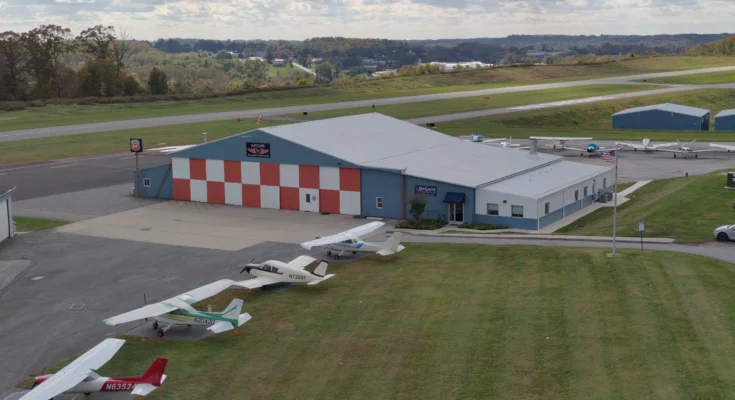
A small plane dips low over Newark Road, its engine cutting a clean line through the late-morning air before leveling out beyond the trees. Below, a pickup turns off Baltimore Pike, tires crunching lightly over gravel as it pulls toward a roadside stand. The smell of earth—rich, damp, unmistakably agricultural—hangs just beneath the surface, even here at the crossroads.
Toughkenamon moves in layers you don’t notice all at once.
The traffic suggests urgency. The fields suggest patience. And somewhere between the two, the community holds its shape—quietly, without insisting on definition.
That balance is what gives Toughkenamon its relevance now. As southern Chester County continues to evolve—pressured by growth along the Route 1 corridor and the expanding influence of nearby Kennett Square—the village sits at a point of convergence. Not just geographically, but economically and culturally, where agriculture, industry, and infrastructure meet without fully overtaking one another.
“It’s busy if you want it to be,” a local vendor says, gesturing toward the road, where cars move steadily past. “But step back a little, and it slows down real quick.”
That duality has deep roots.
Long before the traffic patterns and distribution networks, the land carried a different kind of signal. Early records describe the valley here as Doch ran Amon—later interpreted as “firebrand”—a name tied to Lenape traditions of using fire and light for communication and defense. The terrain itself—set between low ridges, open enough to see across but sheltered enough to hold—shaped how people moved through it, and how they stayed.
By the early 18th century, European settlers had begun to establish themselves, adapting to the land in ways that reflected both necessity and exchange. Farming took hold, and over time, the village formed along what would become Baltimore Pike—a route that connected Philadelphia to Washington, D.C., and brought with it a steady flow of commerce.
The pattern that emerged was less about permanence than function.
“You didn’t come here to stop forever,” a longtime resident says. “You came because it was on the way—and then sometimes, you just stayed.”
That sense of being “on the way” still defines Toughkenamon, but what moves through it has changed.
Today, the area sits at the heart of the nation’s mushroom industry, part of a broader region that supplies a significant share of U.S. production. The work is constant, the scale larger than the landscape might suggest. Trucks move in and out with quiet regularity, carrying perishable goods along distribution routes that extend far beyond Chester County.
And yet, the connection to the land remains immediate.
Drive a few minutes in any direction, and the built environment gives way to open fields and preserved tracts, the kind of landscape that holds its own rhythm regardless of external demand. It’s not untouched—it’s worked, maintained, shaped—but it resists becoming purely utilitarian.
At Harvest Ridge Winery, that balance takes on a different tone. Inside, the space is warm, the light filtered through wide windows that look out toward the edges of the countryside. Glasses clink softly, conversations unfold without urgency. It is not a departure from the agricultural identity of the area, but an extension of it—another way of drawing people into the same landscape.
“People come here to relax,” a staff member says, setting a glass on the counter. “But they’re still in the middle of everything. That’s the part they don’t always expect.”
Not far away, the sound of another aircraft lifts off from New Garden Flying Field, its ascent smooth, almost casual. The airport operates with a kind of understated consistency—less spectacle than function—but its presence adds another dimension to the community’s identity. Events, training flights, and weekend visitors bring movement from above, reinforcing the idea that Toughkenamon is as much a point of passage as it is a place.
Even the ongoing efforts to reshape the village center reflect that tension.
Plans to address congestion, improve pedestrian connections, and refine the streetscape are not about changing what Toughkenamon is, but clarifying it—making the crossroads feel more like a place people can inhabit, not just navigate.
“It’s always been here,” the resident says, watching a car slow at the intersection before turning. “We’re just figuring out how to see it better.”
As the day begins to wind down, the light shifts again. The fields take on a deeper tone, the road softens, and the sound of traffic blends into something less defined. Another plane passes overhead, briefly catching the sun before disappearing beyond the ridge.
For a moment, everything aligns—the movement, the stillness, the space between them.
And in that moment, Toughkenamon feels less like a place you pass through—and more like one that has been holding its position all along, steady as a signal fire, waiting to be noticed.
Support the local news that supports Chester County. MyChesCo delivers reliable, fact-based reporting and essential community resources—free for everyone. If you value that, click here to become a patron today.