
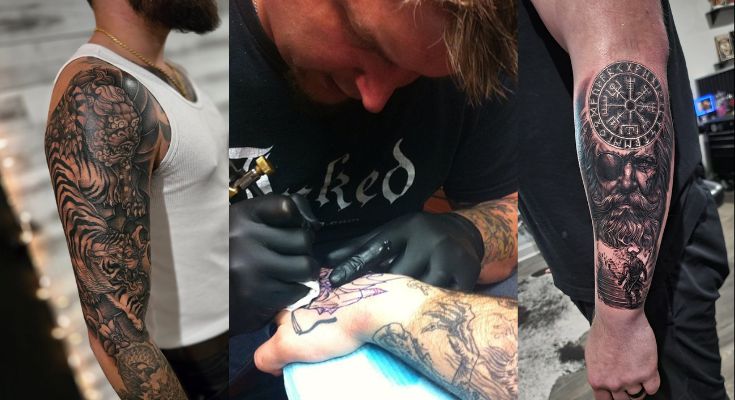
The machine hums low and steady, a sound that lives somewhere between rhythm and restraint. Chris Alexander leans in, gloved hands precise, eyes locked not just on the skin in front of him but on something imagined just beneath it. The stencil has already faded into memory. What remains is instinct—line by line, shade by shade—building something permanent out of trust.
Around him, the atmosphere is different than most tattoo studios. At Revolution Salon in Downingtown, the scent of hair products drifts faintly through the air, blending with the sterile sharpness of ink and antiseptic. A client laughs somewhere across the room. It’s not chaotic. It’s layered.
For Alexander, that layering feels familiar.
“My most challenging adjustment was the technique of tattoo itself—and bringing pain to an innocent person,” he notes, almost matter-of-factly. “But you get over that quick.”
What makes Alexander’s work notable now—after more than two decades tattooing up and down Lincoln Highway—is not just technical skill, but endurance in an industry that has changed dramatically beneath him. As tattooing in Chester County has grown more accepted, it has also become more crowded, more fragmented, and, in his view, more uneven in quality.
“Tattoos have grown, but so have the tattooers,” he says. “Some good, mostly bad… how do you think I got so good at doing cover-ups?”
That edge—equal parts humor and critique—reveals the core of his approach. Alexander is not chasing trends. He’s solving problems.
His background in Graphic Design and Illustration shows up not in flashy declarations, but in structure. Composition, balance, and adaptability define his work more than any single style. While he’s often associated with black-and-gray realism, he resists being boxed in.
“I believe I’m more known for being diverse,” he declares. “Able to custom design in five-plus styles.”
That versatility becomes most visible in his cover-ups—arguably the most technically demanding corner of tattooing. Where others see limitation, Alexander sees a kind of puzzle.
“Cover-ups are not an easy task,” he admits. “It’s hard to put into words how I do it. I guess my strong art and graphic design background helps solve the puzzle.”
Inside Revolution Salon, that mindset fits seamlessly. The shift from a traditional tattoo shop to a multi-service environment hasn’t altered his process as much as it’s refined the conditions around it.
“Every tattoo studio is different,” he states. “Some take care of their artists. Some don’t. In this new position, there is just more care for the staff—and that helps when you’re trying to take care of the client.”
It’s a simple equation, but one that defines his reputation. Clients don’t just come to Alexander for a tattoo—they come for translation. An idea, often vague or deeply personal, becomes something structured, wearable, permanent.
“I would say it’s mostly 50/50,” he explains of his design process. “Just give me your ingredients, and I’ll make your cake.”
That balance—between client vision and artistic execution—is where trust is built. And in a place like Downingtown, where community still carries weight, that trust compounds over time.
“I’ve been tattooing up and down Lincoln Highway for over 25 years,” he declares. “I hope that my loyalty to my home stomping ground does mean something to some.”
It does. His name surfaces regularly in local conversations, recommended not through marketing, but through experience—arm pieces that hold up years later, cover-ups that erase regret, designs that feel like they were always meant to be there.
Even his more intricate work, like dotwork, is approached without pretense.
“It’s a small part of what I do,” he says. “But I do appreciate the textured look it gives the design.”
There’s no romanticizing the process. No mystique. Just craft.
That same grounded perspective carries into his advice for the next generation—a field he sees as both full of opportunity and increasingly risky for newcomers.
“Education is key,” he exclaims. “Come in with a strong art background. Get educated in the tattoo industry so you’re not taken advantage of. Know your worth.”
Then, a pause—followed by something closer to philosophy than instruction.
“A quote from my mentor: ‘Never get cocky, because there is always someone better than you.’”
It’s a line that echoes through his career, visible in the absence of ego even after decades of work. When asked about a “dream piece”—the kind of project many artists imagine but rarely realize—Alexander doesn’t hesitate.
“I don’t have one,” he says. “Because I love working with people, designing for them—not for myself.”
By the time the machine quiets, the piece is finished—or at least paused, waiting for the next session. The client studies it in the mirror, turning slightly, seeing it from angles that will become familiar over time.
Alexander steps back, not to admire, but to assess. There’s always something to refine, something to improve. The work is never really done—it just reaches a point where it belongs to someone else.
Outside, Lincoln Highway moves the way it always has—steady, unremarkable, constant. Inside, the rhythm continues, one piece at a time.
And somewhere in that steady hum, Alexander remains exactly what he’s always been: not just an artist, but a translator of permanence—working quietly, deliberately, and always for someone else.
Support the local news that supports Chester County. MyChesCo delivers reliable, fact-based reporting and essential community resources—free for everyone. If you value that, click here to become a patron today.