
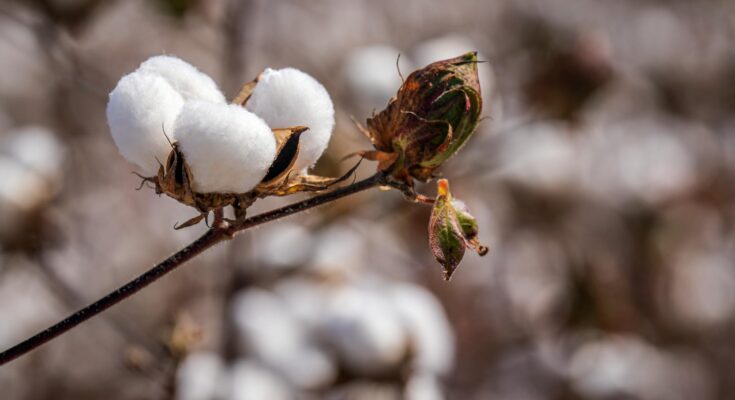
WASHINGTON, D.C. — The U.S. Department of Agriculture has launched a broad initiative aimed at stabilizing the domestic cotton industry after five consecutive years of negative returns, combining trade promotion, manufacturing incentives, risk management programs and consumer marketing efforts as growers face mounting financial pressure.
Agriculture Secretary Brooke Rollins announced the Great American Cotton Plan as USDA projects cotton producers could lose approximately $2.6 billion across 9 million planted acres during the upcoming crop year.
The initiative comes as U.S. cotton producers contend with rising input costs, increased competition from synthetic fibers and foreign producers, and declining domestic textile manufacturing capacity. The United States also lost its position as the world’s leading cotton exporter to Brazil in 2023.
“American cotton once again becomes the fiber of choice” is the goal of the plan, Rollins said, describing the effort as a strategy to improve profitability for growers, strengthen rural economies and support domestic textile production.
USDA estimates that every $1 generated at the farm level produces roughly $15 in economic activity throughout the broader cotton supply chain.
The plan centers on four areas: increasing domestic cotton consumption, expanding manufacturing demand, improving export opportunities and strengthening risk protections for producers.
Among the consumer-focused initiatives, USDA and the Department of Health and Human Services will promote the administration’s “Plant Not Plastic” campaign, which encourages consumers to purchase products made from natural fibers rather than synthetic alternatives.
Federal officials also plan to maintain funding for USDA’s BioPreferred Program, allowing qualifying cotton products to continue using the program’s biobased product designation.
To support domestic manufacturing, USDA will prioritize cotton processors and textile manufacturers through its Rural Development Business and Industry Guaranteed Loan Program. The Economic Adjustment Assistance for Textile Mills payment rate will also increase from 3 cents to 5 cents per pound of cotton processed.
The agency additionally plans to continue supporting the proposed Buying American Cotton Act, which has bipartisan backing in Congress.
On the trade front, USDA is incorporating cotton into the administration’s broader export strategy. Cotton Council International participated in a USDA trade mission to Indonesia earlier this year, and federal officials reported securing commitments from Indonesia and Bangladesh intended to support future purchases of American cotton.
USDA will continue supporting exports through the Market Access Program and COTTON USA licensing initiatives.
The plan also includes measures aimed at reducing production risk. Agricultural Research Service scientists are conducting research on the cotton jassid pest, while growers now have expanded access to Supplemental Coverage Option insurance products.
In addition, legislation approved through the Working Families Tax Cuts Act increased the seed cotton reference price used in Agriculture Risk Coverage and Price Loss Coverage programs by 14 percent beginning in fall 2026.
The announcement follows decades of contraction within the domestic cotton processing sector. USDA data show the number of U.S. cotton gins has fallen from 2,254 in 1980 to 446 today, while domestic textile manufacturing capacity has declined sharply over the past two decades.
Synthetic materials now account for nearly 70 percent of global textile fiber production, according to USDA, with most consisting of petroleum-based products such as polyester.
USDA indicated it will continue working with cotton producers, manufacturers, retailers, industry groups and lawmakers as the agency advances policies designed to strengthen the domestic cotton supply chain.
Support the local news that supports Chester County. MyChesCo delivers reliable, fact-based reporting and essential community resources—free for everyone. If you value that, click here to become a patron today.