
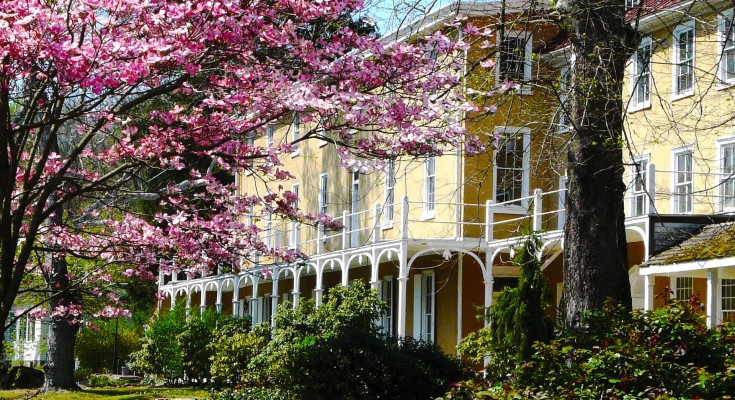
Water slips quietly through the ravine at Yellow Springs, pooling beneath moss-darkened stones before disappearing into the woods below. The air carries the scent of damp earth, wild mint, and old trees, while sunlight filters unevenly through the canopy overhead. Along the narrow paths winding through the village, stone buildings emerge gradually from the landscape—weathered walls, deep porches, tall studio windows catching the afternoon light. Somewhere in the distance, laughter drifts across the grounds from an art class gathered near the old school buildings. Nothing about the village feels hurried, yet every corner seems layered with motion from another century.
Yellow Springs has always been a place where people arrived seeking something.
Healing. Refuge. Reinvention.
Long before the village became an arts center or a historic destination, the Lenape recognized the restorative qualities of the mineral springs flowing through this wooded valley in what is now West Pikeland Township. By the early 1700s, colonial physicians and entrepreneurs were already promoting the iron-, sulfur-, and magnesium-rich waters as curative, establishing one of Pennsylvania’s earliest spa communities around the springs.
Today, that history still lingers in the landscape. Yellow Springs matters now not only because of its extraordinary preservation, but because few places in Chester County embody so many distinct chapters of American life within a single setting. Over three centuries, the village evolved from a colonial health resort into a Revolutionary War hospital complex, a soldiers’ orphan school, an art colony, a film-production campus, and now a nonprofit cultural center. Rather than replacing one identity with another, Yellow Springs absorbed each transformation into itself.
“It’s a place that keeps finding new ways to matter,” one longtime volunteer says while walking past the old PAFA studio buildings. “Most historic places preserve one story. Yellow Springs somehow preserves all of them.”
The springs themselves remain at the center of that story.
Set within a shaded ravine near the heart of the village, the waters once drew visitors from across the region seeking relief from illness and exhaustion. Inns and boardinghouses rose nearby to accommodate guests, and by the mid-18th century the area had developed into a thriving spa village.
Then came war.
In 1777, as British forces advanced toward Philadelphia, George Washington briefly established his headquarters at Yellow Springs before the Continental Congress designated the village as the site of the nation’s first military hospital. The springs’ reputation for healing, combined with the relative seclusion of the landscape, made it an ideal place to care for wounded and sick soldiers.
The ruins of that hospital still remain on the wooded hillside above the village.
Stone foundations and low walls trace the outlines of former wards, kitchens, and supply buildings where Continental Army physicians worked through brutal wartime conditions. The site feels quiet now, almost hidden beneath trees and birdsong, but the scale of the surviving ruins hints at the urgency that once filled the grounds.
“You stand up there and realize this wasn’t symbolic suffering,” the volunteer says softly. “People were dying there. Recovering there. Hoping there.”
Beside the ruins, the Medicinal Herb Garden continues the village’s long connection to healing. Maintained by the Herb Society of America, the garden cultivates traditional remedies once used in colonial medicine—echinacea, lavender, comfrey, feverfew—filling the air with sharp herbal fragrance during warmer months.
The experience is deeply sensory. Bees move lazily between flowering plants. Gravel crunches underfoot. Small signs explain how physicians once relied on botanical knowledge to treat wounds, fever, and infection long before modern medicine existed.
“It makes history feel intimate,” the volunteer says. “Not distant. Human.”
Yellow Springs would reinvent itself repeatedly after the Revolutionary War. In the late 19th century, the Commonwealth converted the village into the Chester Springs Soldiers’ Orphan School, housing children whose fathers died during the Civil War. Decades later, artists from the Pennsylvania Academy of the Fine Arts transformed the campus again, converting former institutional buildings into studios and dormitories for immersive rural art education.
Large north-facing windows were added to capture steady light for painters and sculptors. Barns became studios. Students lived and worked among the wooded hillsides, turning the village into a creative colony shaped as much by landscape as instruction.
That artistic energy carried forward into the mid-20th century, when Good News Productions established a film studio within the former school buildings. Soundstages and editing rooms occupied structures that had once housed soldiers’ orphans and art students. Actors and technicians moved through the same halls where Revolutionary War patients once recovered nearby.
“It’s almost impossible to explain how many lives this place has lived,” the volunteer says with a laugh. “And somehow it all still fits together.”
Today, Historic Yellow Springs preserves the village as both a cultural center and a landscape of memory. Art classes, jazz festivals, exhibitions, weddings, and summer events bring visitors back to the grounds year-round, while trails and conserved open space maintain the quiet, restorative atmosphere that first defined the springs centuries ago.
By late afternoon, golden light settles across the stone buildings and wooded paths. The herb garden grows still. The ravine darkens beneath the trees. Visitors linger near the springs before slowly making their way back toward the parking area, voices softening as evening approaches.
The water continues to move through the village just as it has for hundreds of years.
“It’s funny,” the volunteer says, pausing near the edge of the trail as the sound of the springs rises again through the trees. “People came here looking for healing in 1722. In a way, they still do.”
And as dusk settles over Yellow Springs, the village seems to hold that possibility gently within itself—quiet, enduring, and still alive with reinvention.
Support the local news that supports Chester County. MyChesCo delivers reliable, fact-based reporting and essential community resources—free for everyone. If you value that, click here to become a patron today.