
Morning sunlight glitters across the surface of Marsh Creek Lake as kayakers push quietly away from shore. A great blue heron lifts from the reeds and glides low across the water. Just a few miles away, commuters stream along Route 100, coffee cups in hand, heading toward offices in Exton, King of Prussia, and Philadelphia. Between those two worlds—the natural and the modern—sits Upper Uwchlan Township.
It is a community defined by movement.
Water moves through the Marsh Creek watershed. Traffic flows along roads that have guided travelers for centuries. New families continue to arrive, drawn by highly rated schools, open space, and proximity to major employment centers. Yet amid that growth, Upper Uwchlan has managed to preserve a surprising connection to the landscape and history that shaped it.
That balance feels increasingly important today.
Few places in Chester County illustrate the region’s evolution quite as clearly. Once a sparsely populated farming community settled largely by Welsh immigrants, Upper Uwchlan has become one of the county’s most educated and prosperous municipalities. Even as neighborhoods expand and population growth accelerates, historic villages, preserved waterways, and centuries-old landmarks continue to anchor the township’s identity.
Its story begins long before modern subdivisions appeared on former farmland.
Upper Uwchlan was incorporated in 1858 after residents of the northern section of Greater Uwchlan Township sought a more manageable local government. The original township had grown too large to administer efficiently, stretching across more than 22 square miles of rolling countryside.
The landscape itself shaped much of what followed.
Positioned between the North Valley Hills and the Nantmeal Hills, the township sits within Pennsylvania’s Piedmont region, where gentle ridges, fertile soils, and winding waterways encouraged settlement. Marsh Creek became the defining natural feature, draining much of the township before ultimately feeding the Brandywine Creek watershed.
Those waters continue to shape daily life.
Today, Marsh Creek Lake and the surrounding state park serve as one of Chester County’s most beloved outdoor destinations. Created in the 1970s as part of a regional water-management project, the reservoir transformed the area into a recreational hub where visitors sail, fish, kayak, hike, and observe migratory birds.
On summer weekends, the lake becomes a gathering place for families from throughout southeastern Pennsylvania.
Yet despite its popularity, the park retains a sense of escape. Woodlands border the shoreline. Trails disappear into stands of oak and maple. Bald eagles and osprey occasionally appear overhead. It remains one of the county’s most successful examples of balancing recreation with conservation.
History reveals itself in quieter ways elsewhere across the township.
At the crossroads of Route 100 and Little Conestoga Road sits Eagle Village, the historic heart of Upper Uwchlan. Long before traffic signals and modern development arrived, this was a vital stopping point for travelers moving between the Delaware and Susquehanna river systems.
Little Conestoga Road itself carries remarkable history.
Once known as the Allegheny Path, it is considered one of the oldest transportation routes connecting eastern and western Pennsylvania. Stagecoaches, wagons, farmers, merchants, and travelers all passed through Eagle, helping transform the village into a thriving commercial center.
The rerouting of what would become Route 100 in 1839 only strengthened that role.
Traffic increased. Businesses followed. The Eagle Tavern became a focal point of community life. Although modern development has expanded around it, the historic crossroads still functions as the township’s symbolic center.
Other reminders of the past remain tucked into the landscape.
The Byers Station Historic District preserves the character of a nineteenth-century railroad and mining village, where graphite extraction and rail transportation once fueled the local economy. Stone houses, historic streetscapes, and surviving village buildings offer a glimpse into a period when industry—not residential development—drove growth.
Nearby, the Larkin Covered Bridge stands as one of the township’s most picturesque landmarks.
Its weathered red siding and wooden Burr-arch truss evoke an era when covered bridges served as critical links between farms, mills, and neighboring communities. Though no longer carrying vehicle traffic, having been physically moved by the Commonwealth in 1972 to prevent its submergence when Marsh Creek Lake was created, the bridge remains a cherished reminder of Chester County’s agricultural heritage.
The Wheelen House tells an even older story.
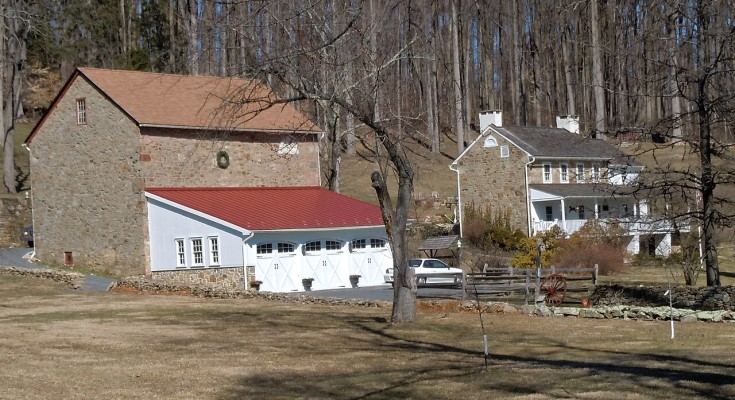
Built around 1750, the handsome Georgian fieldstone residence reflects the craftsmanship and permanence sought by early settlers. Thick stone walls, carefully proportioned architecture, and a preserved rural setting have allowed the property to endure for nearly three centuries.
Yet Upper Uwchlan is not defined solely by its past.
Today, it is one of Chester County’s fastest-growing communities. Highly ranked schools, strong household incomes, and convenient access to employment centers have attracted a diverse and increasingly global population. Nearly a quarter of residents were born outside the United States, contributing to a community that looks very different from the one early Welsh settlers established.
That diversity has become one of the township’s defining strengths.
Modern neighborhoods sit alongside historic farms. New residents share community spaces with families whose roots stretch back generations. The result is a township that feels both forward-looking and deeply grounded in place.
Perhaps that is Upper Uwchlan’s greatest achievement.
Growth has arrived, but the landscape still matters.
The creeks still define the terrain. The historic crossroads still shape community identity. Open spaces still provide room to breathe. And residents continue to invest in preserving the natural and historic resources that make the township distinctive.
As evening settles over Marsh Creek Lake, the last sailboats drift toward shore. Sunlight fades across the water while the hills beyond Eagle turn blue in the gathering dusk. Along trails, roads, and quiet neighborhoods, another day comes to a close.
The water keeps moving through the watershed.
Just as it did when Welsh settlers first arrived.
Just as it did when stagecoaches rolled through Eagle.
And in Upper Uwchlan Township, it remains a reminder that the most successful communities are often those that find a way to carry their history forward while continuing to grow.
Support the local news that supports Chester County. MyChesCo delivers reliable, fact-based reporting and essential community resources—free for everyone. If you value that, click here to become a patron today.