
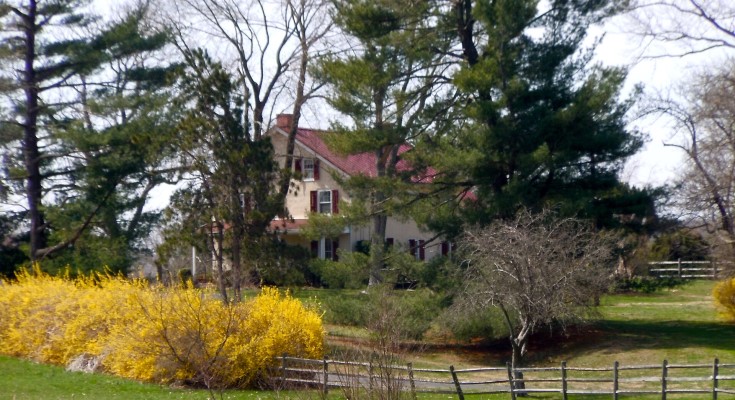
Morning comes quietly to Coventryville. A thin mist lingers above French Creek, softening the stone walls and old rooflines that line the valley road. In the trees beyond the village, birdsong gathers before the first cars pass through. The creek moves over rock and shadow, following the same course that once powered one of Chester County’s earliest ironmaking communities.
The village feels almost hidden, folded into the landscape.
A short drive away, the intersection of Routes 23 and 100 carries the familiar movement of modern life—school buses, commuters, parents headed toward the Owen J. Roberts campus. Yet beyond the traffic, South Coventry Township remains anchored by a quieter identity: old villages, wooded hillsides, and a history shaped by iron, agriculture, and the enduring pull of rural place.
That balance gives South Coventry its meaning now.
As northern Chester County continues to grow, the township occupies a rare position within the Hopewell Big Woods, one of southeastern Pennsylvania’s most important forested landscapes. It is not untouched by change, but it has retained a distinctive sense of place—one defined by preserved villages, historic roads, rural homes, and woodlands that still shape daily life. In a region where development often erases context, South Coventry’s past remains unusually visible.
The township’s modern boundaries date to 1841, when the original Coventry Township was divided into North and South Coventry.
Its name reaches farther back, to Coventry, England, the home of Samuel Nutt, the ironmaster whose work helped shape the region’s early industrial identity. Nutt and his contemporaries recognized what French Creek could provide: waterpower, timber, ore, and access to a growing colonial economy. From those ingredients emerged Coventry Forge and the village that grew around it.
Coventryville became more than a workplace.
It was a self-contained industrial community, a place where ironmasters, laborers, tradesmen, and families lived within the rhythms of the forge. Stone workers’ houses, larger residences, a village inn, religious buildings, and the remnants of industrial sites formed a landscape where labor and domestic life stood side by side.
Much of that fabric remains.
The Coventryville Historic District preserves one of Chester County’s most evocative early industrial villages. Unlike places where history has been reduced to a marker or a single restored building, Coventryville still reads as a complete settlement. The road, the creek, the houses, and the surrounding valley all contribute to the story.
Coventry Hall stands as one of its most commanding chapters.
Built for Samuel Nutt, the stone residence reflects the ambition and confidence of an ironmaster’s world. Its thick walls and balanced proportions suggest both practicality and status, a home designed not merely for shelter but for presence. From its rise above the former forge, Coventry Hall still watches over the village landscape that Nutt helped create.
Other historic homes deepen that sense of continuity.
In Pughtown, the Townsend House recalls the agricultural and crossroads life that shaped another of the township’s villages. The Simon Meredith House, Stephen Meredith House, and Nathan Michener House each preserve pieces of the broader rural world that grew around South Coventry’s early roads, farms, and industries.
Together, they reveal a township built not around a single center, but around a constellation of small places.
Bucktown, Coventryville, and Pughtown each carry their own identity. Their names remain familiar to residents, used in directions, family stories, school conversations, and memories of older landscapes. In that way, South Coventry has preserved something more subtle than architecture: the village vocabulary of rural Pennsylvania.
The land reinforces that identity.
South Coventry lies within the Hopewell Big Woods, a vast forested landscape stretching across northern Chester and western Montgomery counties. Its woodlands form part of a larger ecological network of streams, ridges, wildlife corridors, and protected open space. For residents, the woods are not abstract conservation acreage. They are the backdrop to everyday life.
They edge back roads.
They shelter deer and foxes.
They turn gold in autumn and darken the hillsides in winter.
The forested setting also helps explain why South Coventry continues to feel different from more heavily developed parts of Chester County. Homes sit among trees and fields. Roads curve with the land. Open space still shapes the experience of moving through the township.
At the same time, South Coventry is not isolated.
The Owen J. Roberts School District campus at Routes 23 and 100 serves as one of the township’s most important modern landmarks, drawing families from across the region and giving the community a daily pulse. School events, sports, performances, and gatherings provide a contemporary counterpoint to the township’s older village centers.
That blend of old and new defines South Coventry today.
Its residents live amid historic houses and modern subdivisions, rural lanes and commuter routes, preserved forests and school campuses. The population remains modest, just under 3,000 residents, yet the township carries a historical weight disproportionate to its size.
As evening settles over Coventryville, the light fades from the stone houses along the road. French Creek darkens beneath the trees. The sounds of traffic near Route 100 recede, replaced by the hush of water moving over stone.
The forge fires are long gone.
But in the village, the creek, and the woods beyond, South Coventry Township still carries the imprint of the people who built their lives around them.
Support the local news that supports Chester County. MyChesCo delivers reliable, fact-based reporting and essential community resources—free for everyone. If you value that, click here to become a patron today.