
Early morning sunlight filters through the sycamores along the Brandywine River, turning the water into a ribbon of silver as it slips quietly south toward Delaware. Mist hangs over open fields. A red barn emerges from the fog. Along a winding country road, cyclists pedal past stone farmhouses that have watched over this landscape for two centuries or more.
The scene feels familiar to anyone who knows the Brandywine Valley. Yet in Pennsbury Township, that sense of continuity runs unusually deep.
Here, the landscape is not simply scenic—it is historical. The farms, meetinghouses, crossroads villages, and wooded stream valleys that define the township today are remarkably similar to those that greeted Quaker settlers three centuries ago. As development continues to reshape portions of southeastern Pennsylvania, Pennsbury has become a quiet example of how a community can grow while remaining deeply connected to its origins.
That balance matters now more than ever.
Situated along one of the most desirable corridors between Philadelphia and Wilmington, Pennsbury Township faces the same pressures confronting many affluent suburban communities: growth, rising property values, and changing demographics. Yet unlike many places where history survives only in museums, Pennsbury’s past remains embedded in the everyday landscape, visible from nearly every road and ridgeline.
Its story begins with William Penn.
The township emerged from the lands of Kennett Township, part of Penn’s original colonial vision for Pennsylvania. Settlement accelerated after 1700 as Quaker families established farms along the west bank of the Brandywine River. Names such as Smith, Peirce, Hope, Harlan, Few, Huntley, and Brinton became woven into the region’s identity, creating an agricultural community built around grain production, livestock, and stewardship of the land.
The influence of those families remains surprisingly visible.
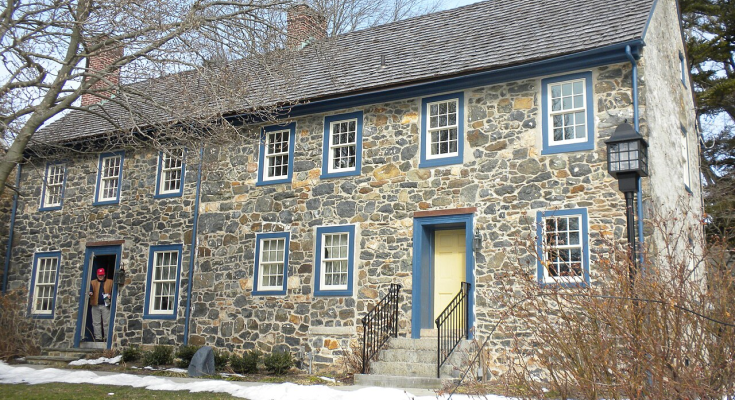
Driving through Pennsbury today often feels like traveling through a living archive of the Brandywine Valley. Stone farmhouses sit behind centuries-old trees. Historic barns overlook open fields. Narrow roads follow routes first established long before automobiles existed.
The township itself formally separated from Kennett Township in 1770, just a few years before events would thrust the region into the center of American history.
In September 1777, British forces advanced through the Brandywine Valley on their way toward Philadelphia. General George Washington’s army positioned itself nearby in what became the Battle of Brandywine, the largest land battle of the Revolutionary War. While the fighting occurred primarily east of the river, Pennsbury’s roads, farms, and homesteads lay within the broader landscape through which armies moved and supplies flowed.
Today, reminders of that era remain remarkably intact.
Among the most significant is the Barns-Brinton House.
Built in 1714 by blacksmith William Barns, the handsome Flemish-bond brick structure once operated as a tavern serving travelers along Nottingham Road, now U.S. Route 1. Its patterned brickwork, original wood detailing, and carefully preserved interior spaces provide a rare glimpse into colonial life. Maintained today by the Chadds Ford Historical Society, it stands as one of the township’s most important architectural treasures.
Yet the Barns-Brinton House is far from alone.
Pennsbury contains an extraordinary concentration of National Register-listed properties, including the Brinton-King Farmstead, Oakdale, Springdale Farm, the William Peters House, the William Harvey House, and the Peter Harvey House and Barn. Together, they tell a story of agricultural prosperity and long-term stewardship that shaped the Brandywine Valley throughout the eighteenth and nineteenth centuries.
What makes these places remarkable is not merely their survival.
It is their setting.
Unlike historic homes isolated by modern development, many of Pennsbury’s landmarks remain surrounded by rolling fields, mature woodlands, and open vistas that preserve the context in which they were built. The architecture and landscape continue to complement one another in ways that are increasingly rare.
That relationship between people and place is perhaps most visible in Fairville.
Straddling the Pennsylvania-Delaware border, the Fairville Historic District developed along Kennett Pike as a service village for travelers moving between Wilmington, Kennett Square, and Chadds Ford. Stone homes, Victorian residences, former shops, and farmsteads line the road beneath mature trees, creating one of the Brandywine Valley’s most atmospheric historic corridors.
Nearby, the Parkersville Friends Meetinghouse offers another window into the township’s Quaker roots.
Built in 1830, the modest stuccoed stone structure reflects the simplicity and restraint that characterized Hicksite Quaker architecture. The meetinghouse remains a powerful reminder that Pennsbury’s history is not only agricultural but spiritual, shaped by communities that valued humility, contemplation, and connection to the land.
Those values continue to influence the township today.
Modern Pennsbury is prosperous, highly educated, and increasingly connected to the broader Wilmington-Philadelphia economy. Yet despite its affluence, the community has consistently emphasized preservation. Open-space protection, low-density development, and environmental stewardship remain central priorities.
The township’s 54-acre park reflects that commitment.
Walking trails wind through wooded areas and open fields. Families gather for picnics. Dogs race across open spaces. The park functions not only as a recreational asset but as a statement about what residents value: maintaining access to the landscapes that define the community.
That commitment extends beyond recreation.
The Brandywine River and its tributaries remain ecological anchors, supporting wildlife habitats, wooded stream corridors, and scenic views that contribute to the character of the township. These natural systems help explain why Pennsbury continues to feel more rural than many communities located so close to major metropolitan centers.
As evening settles across the Brandywine Valley, sunlight fades from the stone walls of old farmhouses. Shadows lengthen across pastures and wooded hillsides. Along the river, the last reflections of the day shimmer briefly before disappearing into darkness.
The landscape grows quiet.
Much as it did centuries ago.
And in that quiet, Pennsbury Township reveals its enduring appeal—not as a place frozen in time, but as a community that has learned how to carry its history forward without losing sight of the land that made it possible.
Support the local news that supports Chester County. MyChesCo delivers reliable, fact-based reporting and essential community resources—free for everyone. If you value that, click here to become a patron today.