
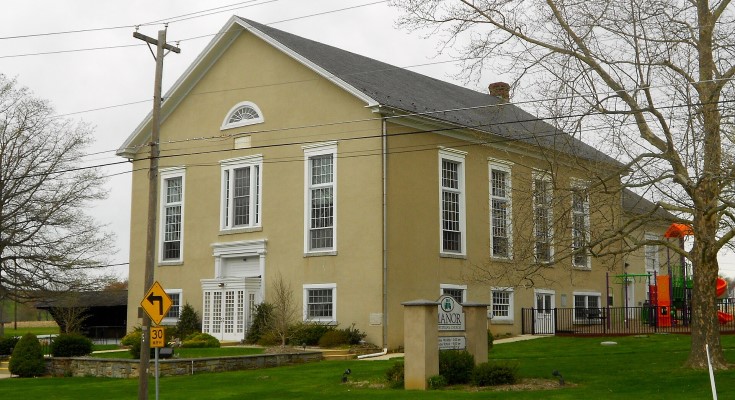
The road runs straight until it doesn’t. Just past the bend along Route 926, the land opens into a wide, quiet sweep of fields. Their edges are softened by low stone walls and scattered trees, the landscape unfolding without urgency. A small church rises from the distance without announcement—no steeple competing with the sky, no grand approach—just a steady presence set back from the road, as if it has always belonged there.
On a still morning, you can almost hear what once gathered here.
Not the hush of today, but the murmur of voices—thousands of them—spilling across the fields, pressing close to hear a man speak. Horses tied along the roadside. Wagons lined in rows. A congregation too large for walls, carried instead by open ground and expectation.
It is difficult to reconcile that scene with the one that exists now. And yet, that tension—between scale and stillness—is precisely what defines Faggs Manor today.
In a region where growth and change often reshape the landscape, this small hamlet in Londonderry Township remains anchored in something older: a place where belief once drew crowds large enough to rival cities, and where the physical setting has changed remarkably little since.
“It’s hard to imagine now,” a longtime resident says, standing near the edge of the cemetery. “But this was once one of the most important places around.”
That importance began in the early 18th century, when Scotch-Irish settlers established roots on land originally surveyed for William Penn’s daughter, Letitia. At the crossroads of two early colonial paths, the community that would become Faggs Manor took shape around agriculture, water access, and, most enduringly, faith.
By the 1730s, the Faggs Manor Presbyterian Church had been founded—a modest structure that would soon become the center of a much larger movement.
Under the leadership of Rev. Samuel Blair, the church emerged as a focal point of the New Light revival, part of the broader Great Awakening that swept through the American colonies. Blair’s preaching, known for its intensity and intellectual depth, drew listeners from across Pennsylvania and beyond. At times, the crowds reached into the thousands.
“He wasn’t just preaching to the local congregation,” the resident says. “People traveled to be here.”
Among those who came was George Whitefield, one of the most famous evangelists of the era, whose sermons at Faggs Manor reportedly drew as many as 12,000 people—a staggering number for a rural setting that, even then, remained largely agricultural.
This is why Faggs Manor matters now.
Not because of what it has become, but because of what it has managed to hold onto. In an age when historic places are often reduced to markers or memory, this landscape still reads as it did centuries ago—a living environment where the scale of past events can still be felt, if only faintly, in the space itself.
“It hasn’t been overwritten,” the resident says. “That’s the rare part.”
The church, rebuilt in 1846, remains the visual and spiritual anchor of the hamlet. Its stone walls carry forward the legacy of Blair’s ministry, while the adjoining cemetery holds the names of the families who shaped the community—weathered markers standing in quiet rows, their inscriptions softened by time.
Nearby, other landmarks extend that sense of continuity.
Saint Malachi Roman Catholic Church, established in 1771, reflects the broader religious landscape that developed alongside the Presbyterian tradition. The Doe Run Meeting House, built in 1805, speaks to the region’s Quaker presence. Together, they form a network of rural worship sites that once defined daily life across this part of Chester County.
Yet Faggs Manor was never solely about faith.
The surrounding farmland—still active, still open—tells a parallel story of work and sustenance. Fields that once grew wheat, corn, and buckwheat continue to shape the view, their boundaries largely unchanged. Streams that powered early mills still trace their way through the Big Elk Creek watershed, connecting the hamlet to a broader agricultural system that has endured for generations.
There are no commercial centers here, no concentrated development. Just roads that connect, rather than converge. A landscape that remains functional, rather than transformed.
As the light shifts toward evening, the fields take on a deeper tone, the greens turning muted, the sky widening overhead. The church stands as it has for decades, unchanged in form, steady in presence.
“It’s quieter now,” the resident says, looking out across the open ground. “But it still feels like something happened here.”
The wind moves lightly across the fields, bending the tops of the grass in a slow, coordinated sweep. For a moment, the land seems to carry that earlier energy—not loudly, not insistently, but enough to suggest it hasn’t entirely disappeared.
The road curves again as it leaves the hamlet, returning to its steady line.
Behind it, Faggs Manor remains—unchanged in its essentials, defined not by what has been added, but by what has been allowed to remain.
Support the local news that supports Chester County. MyChesCo delivers reliable, fact-based reporting and essential community resources—free for everyone. If you value that, click here to become a patron today.