
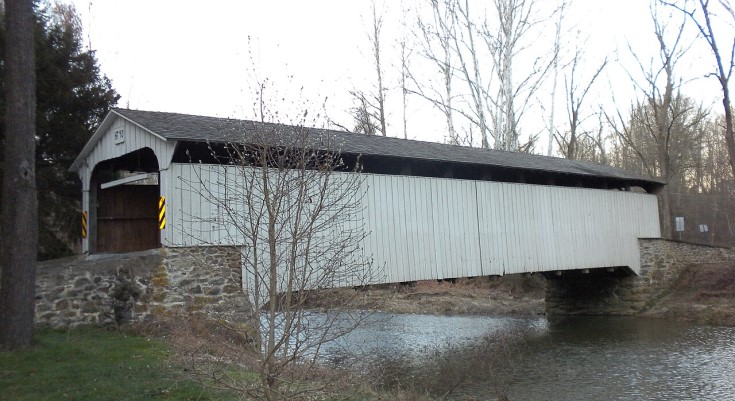
Morning fog rises slowly from Big Elk Creek, drifting between weathered fence posts and open pastureland as sunlight spreads across the fields outside Lewisville. A pickup truck rumbles down a narrow country road. Nearby, the wooden timbers of a covered bridge emerge from the mist, their familiar silhouette standing much as it has for generations. The creek below moves quietly, unconcerned with the passing decades.
In Elk Township, time seems to move at a different pace.
The landscape unfolds in long views of farmland, winding roads, and wooded stream valleys. Historic bridges still connect neighboring communities. Farmhouses sit back from the road behind rows of mature trees. Even today, it is possible to drive for miles without encountering the commercial corridors and suburban density that have transformed so much of southeastern Pennsylvania.
That sense of continuity has become increasingly significant as Chester County continues to grow. While many communities have experienced rapid development, Elk Township remains one of the county’s most distinctly rural municipalities—a place where agricultural traditions, historic preservation, and open space continue to shape daily life. The township’s appeal lies not in what has been added, but in what has endured.
Located just north of the Maryland border, Elk Township occupies a quiet corner of southern Chester County where rolling hills and narrow valleys define both the scenery and the rhythm of life. The community traces its origins to 1857, when it was carved from neighboring East Nottingham Township. Growth arrived gradually, centered on crossroads communities such as Lewisville, once known as the “Head of Elk.”
The roads that intersect in Lewisville remain the township’s crossroads today.
At the junction of Routes 472 and 841, the village serves as a modest center of community life. The preserved Lewisville Inn, built around 1854, recalls an era when travelers moving between Pennsylvania and Maryland depended upon roadside taverns and inns for food, lodging, and conversation. Though no longer operating in its original role, the building remains a visible reminder of the township’s transportation history and rural heritage.
Few places capture Elk Township’s character more completely than its covered bridges.
Scattered across the countryside, these historic timber structures—celebrated for their profound National Register heritage—have become enduring symbols of the community. They are not museum pieces tucked away behind barriers. They remain part of the landscape itself, woven into everyday life.
The Glen Hope Covered Bridge, spanning Little Elk Creek west of Lewisville, appears almost cinematic in its setting. Its timber frame, vertical plank siding, and weathered character evoke a period when local craftsmen built structures designed to last generations. Surviving fire damage and restoration efforts over the years, the bridge remains one of Chester County’s most recognizable historic landmarks.
Along Big Elk Creek, the Linton Stephens Covered Bridge reflects another chapter of the township’s story. Built in 1886, the bridge has endured floods, storms, and changing transportation needs while maintaining the elegant simplicity that defines Chester County’s covered-bridge tradition. Its graceful timber framework remains a testament to nineteenth-century engineering and craftsmanship.
Perhaps no bridge better symbolizes resilience than the Rudolph and Arthur Covered Bridge, which spans Big Elk Creek to connect Elk and New London townships.
Originally constructed in 1880 and long honored on the National Register of Historic Places, the original structure was completely destroyed by the remnants of Hurricane Ida in 2021. For many communities, such a loss might have marked the end of a historic landmark. Here, it became a call to preserve a piece of local identity. Following a painstaking reconstruction that replicated its historic Burr arch truss design, the bridge reopened in late 2025—restoring not only a vital physical link between neighboring communities but also a piece of the landscape itself.
The township’s history extends beyond transportation.
Tucked within the Hickory Hill area stands the Little Elk Friends Meeting, a modest stone meetinghouse built in 1826. The structure reflects the influence of Quaker families who helped shape southern Chester County during the nineteenth century. Its simple design, quiet burial ground, and rural setting embody the values of simplicity and stewardship that continue to influence the region’s character.
Those values remain visible across Elk Township today.
Agriculture continues to define much of the local economy and landscape. Fields of corn, soybeans, hay, and pasture stretch across the township’s rolling terrain. Family farms remain active. Open space preservation remains a priority. The result is a community where development has occurred, but not at the expense of the landscape that residents value most.
The township’s population has grown steadily in recent years, bringing new families while preserving its close-knit rural identity. Residents often commute to Oxford, West Grove, Newark, and other nearby employment centers, yet many return home seeking something increasingly difficult to find: space, quiet, and connection to the land.
Seasonal rhythms still matter here.
Spring arrives in bright green pastures and blooming hedgerows. Summer brings long evenings across open fields. Autumn paints the creek valleys in gold and crimson. Winter settles softly across barns, bridges, and country roads.
The appeal of Elk Township is not found in grand attractions or crowded destinations. It is found in smaller moments—the sound of water moving beneath a covered bridge, the sight of fog lifting from a pasture, the silhouette of an old meetinghouse standing quietly against the horizon.
As the morning mist fades from Big Elk Creek and sunlight reaches the weathered timbers of the bridges once more, Elk Township reveals what has always been its greatest strength: a landscape that remembers where it came from and sees no reason to hurry toward becoming something else.
Support the local news that supports Chester County. MyChesCo delivers reliable, fact-based reporting and essential community resources—free for everyone. If you value that, click here to become a patron today.