
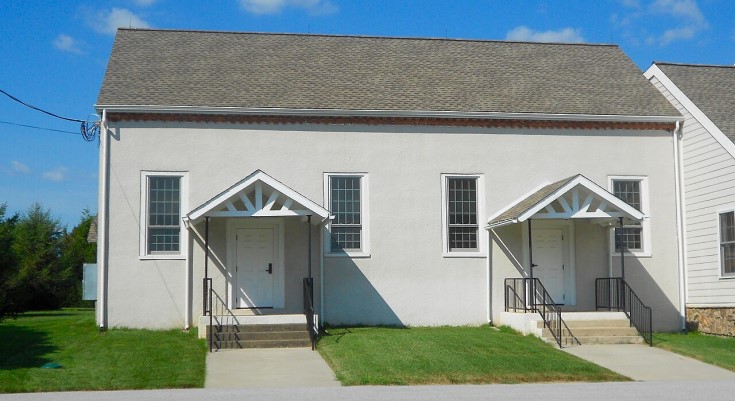
The road narrows just before the turn, dipping slightly beneath a canopy of trees that filter the light into something softer, almost deliberate. Gravel shifts under tires as a car slows near the intersection of Doe Run and Wollaston Roads. A porch sits close to the lane, its paint worn in a way that feels earned rather than neglected. Somewhere nearby, the faint smell of wood smoke lingers, even in daylight.
Unionville does not feel like it has been preserved. It feels like it has simply continued.
At the center of the village, the buildings gather without crowding—stone, brick, and frame structures set close enough to suggest conversation, spaced enough to allow for quiet. There are no sharp edges, no abrupt transitions. The past and present move together here, indistinguishable at a glance.
That continuity is what gives Unionville its weight now. In a region where development continues to press outward—reshaping farmland, redrawing edges, accelerating the pace of change—Unionville remains one of the few places where the original pattern still holds. Not as a museum, but as a functioning village that never stepped out of its own timeline.
“It’s not frozen,” a resident says, standing near the crossroads as a car rolls slowly through. “It just never needed to catch up.”
The village began, as many do, with land and necessity. In 1706, Henry Hayes established the first homestead near the headwaters of the Red Clay Creek, followed soon after by other families who recognized the value of its location. By the mid-18th century, the settlement—then known as Jacksonville—had become a waypoint for drovers moving livestock between larger markets. Inns, blacksmith shops, and general stores took shape around that movement, forming a compact center built entirely on function.
What remains today still reflects that origin.
The Unionville Village Historic District holds its structure with quiet confidence. Buildings align along the roads not for aesthetic effect, but because they were meant to be reached, entered, used. Mature trees frame the streets, their roots older than most of what surrounds them. The scale has never expanded beyond what the land and its use required.
“It was built to serve people passing through,” the resident says. “And then it ended up serving the people who stayed.”
That shift—from transient to rooted—is visible in the way the village breathes now.
Hood’s BBQ sits close to the center, its presence marked less by signage than by scent. The air carries the slow, unmistakable note of smoked meat, drifting outward in a way that draws people in without urgency. Inside, the atmosphere is warm, the kind shaped by repetition—regulars, familiar orders, conversations that pick up where they left off.
“It’s simple,” a customer says, settling into a seat. “Good food, same faces. That’s enough.”
Beyond the village core, the land opens almost immediately.
Fields stretch outward in long, unbroken lines, bordered by hedgerows and narrow roads that curve with the terrain. Preserved spaces—ChesLen, the Red Clay lands—extend that openness, creating a sense that the village exists not apart from its surroundings, but within them. The transition is seamless, almost invisible.
It is this integration that defines Unionville more than anything else.
With fewer than 600 residents, the village remains small by any measure, but its influence extends beyond its size. The school district draws families seeking stability and continuity. The surrounding equestrian culture adds another layer—movement of a different kind, quieter, more deliberate.
And yet, nothing here feels curated.
There are no banners announcing significance, no markers insisting on importance. The value of Unionville reveals itself through experience—through the way the roads meet, the way the buildings hold their place, the way the landscape remains intact without explanation.
As the day fades, the light settles lower across the crossroads. Shadows lengthen, stretching across the narrow lanes and up against the stone walls that have held their position for centuries. A car passes, slower now, as if responding to something unspoken.
“It’s not about going back,” the resident says, watching the road as it quiets again. “It’s about not losing what was already here.”
The last of the light slips through the trees, catching briefly on the edges of the buildings before fading. The intersection remains, unchanged in form, unchanged in purpose.
And in that stillness—where roads meet, where time layers rather than replaces—Unionville continues, not as a memory, but as a place that never left.
Support the local news that supports Chester County. MyChesCo delivers reliable, fact-based reporting and essential community resources—free for everyone. If you value that, click here to become a patron today.