
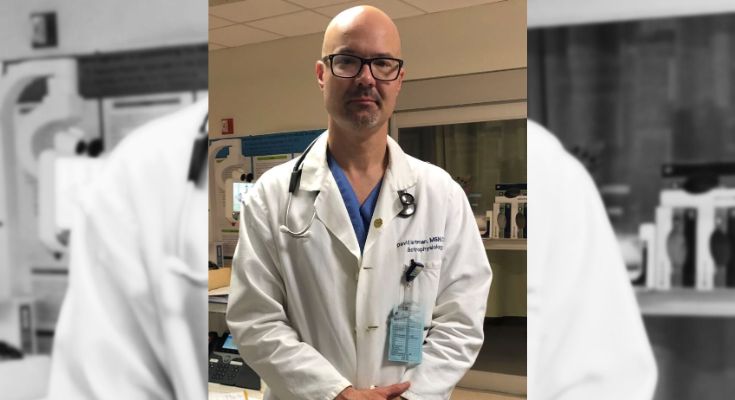
At 11:00 p.m., he did what Americans are told to do in their darkest moments:
He asked for help.
He called 911 and requested an ambulance—only an ambulance. He told the operator he was in crisis, that his thoughts were spiraling, that he feared what he might do to himself. He did not ask for police. In fact, he explicitly feared them.
Then he waited.
More than an hour passed.
In that hour, he sat alone with thoughts that were actively trying to kill him—part of a much larger national crisis. Each year, more than 12 million Americans report serious thoughts of suicide, and nearly 1 in 5 adults lives with a mental illness. Yet access to timely care remains inconsistent, fragmented, and often delayed.
“I didn’t want to die,” he would later say. “I wanted the pain to stop.”
By the time he stepped outside, expecting transport to a hospital, the system had already made a different decision.
Waiting for him were multiple police vehicles.
A System Built Around the Wrong Default
Across the United States, 911 remains the primary gateway for mental health emergencies. But in practice, that gateway is still controlled by law enforcement.
Research shows that police are routinely dispatched to mental health calls—even when medical assistance is requested. In many cases, dispatchers already know the individual is experiencing a psychiatric crisis before officers arrive.
This creates a dangerous mismatch:
A medical emergency meets a law enforcement response.
And the outcome depends on interpretation—not treatment.
From Patient to Suspect in Seconds
As he approached the scene, he tried to communicate the one thing that mattered:
He was not a threat.
He attempted to show he was unarmed. He spoke. He complied.
What followed, according to his account, was immediate escalation.
He was taken to the ground, struck, and restrained in the rain. At one point, his face landed in a puddle. He says an officer held his head down, restricting his ability to breathe.
Moments earlier, he had been a patient.
Now, he was part of a broader statistical pattern: each year in the United States, roughly 1 million people experience police use or threat of force, and approximately 250,000 are injured during those encounters.
About 15% of use-of-force incidents result in injury.
His experience was not an outlier.
It was predictable.
The Mental Health–Police Violence Intersection
The overlap between mental illness and police force is one of the most documented—and least resolved—failures in American public safety.
- Nearly 1 in 3 police shootings involve a person in mental health crisis
- More than 2,000 people in crisis have been killed by police in the past decade
- Many of those encounters begin the same way: a call for help
This case follows that same trajectory:
Help requested → police dispatched → escalation → force.
Sedation and Control
After the encounter, he was placed in an ambulance—but not immediately treated.
At some point, he was injected with a large dose of Ketamine.
Ketamine has become increasingly controversial in law enforcement–adjacent medical response. Originally used as an anesthetic, it is now sometimes administered in the field to sedate individuals deemed agitated.
Critics—including civil rights advocates and medical professionals—have raised concerns about:
- Use without meaningful consent
- Dosing under chaotic conditions
- Deployment as a compliance tool rather than a medical necessity
In this case, the injection rendered him unconscious.
He woke up restrained in a hospital bed.
From Crisis to Criminal Charge
Instead of receiving sustained psychiatric care, the situation escalated further.
He was charged with making a “terroristic threat,” based on a text message sent during his breakdown.
He was taken to jail.
This transition—from patient to defendant—is not uncommon. Across the country, individuals in crisis are frequently routed into the criminal justice system, where the consequences multiply:
- Arrest records
- Bail requirements
- Court proceedings
- Long-term financial and legal damage
He posted $15,000 bail.
Arrested Again—While Under Psychiatric Hold
While still under medical supervision, another police department traveled more than 50 miles to arrest him again for the same incident.
He was shackled, transported, processed—and eventually released.
Not to a treatment facility.
Not to supervision.
But to an Uber.
Eighteen hours after asking for help, he was back where he started:
Alone.
The Part No System Tracks
There is no national system that measures what happens after a mental health crisis call ends.
No database tracking:
- Patients discharged without care
- Individuals released while unstable
- Post-encounter psychological deterioration
In this case, the aftermath was immediate.
For two weeks, he isolated himself inside his apartment. He stopped eating. He stopped bathing. He slept in a closet, placing barriers between himself and the outside world.
“The people who were supposed to help me,” he said, “made it worse.”
A Pattern, Not an Exception
This case mirrors a growing list of national incidents:
- Elijah McClain (Colorado) — restrained and injected with ketamine; died days later
- Daniel Prude (New York) — restrained after a mental health call; died of asphyxia
- Walter Wallace Jr. (Philadelphia) — family requested help; police shot and killed him
Each began with a crisis.
Each ended with escalation.
The Question That Remains
He followed every instruction society gives people in crisis:
Call for help.
Stay on the line.
Wait.
“I did everything right,” he said.
“And it still went wrong.”
TIMELINE: FROM 911 CALL TO SYSTEM FAILURE
11:00 PM — Crisis Begins
- Subject experiences acute mental health breakdown
- Suicidal ideation escalates
11:05 PM — 911 Call Placed
- Requests ambulance only
- Explicit fear of police involvement
11:05–12:05 AM — 60+ Minute Delay
- Remains on phone with dispatcher
- Condition deteriorates
~12:10 AM — Responders Arrive
- Multiple police units present
- EMS staged
Moments Later — Use of Force
- Physical takedown
- Head forced into puddle
- Injury sustained
~12:30–1:30 AM — Ambulance Containment
- No immediate hospital transport
- Continued distress
~1:30 AM — Ketamine Injection
- 300 mg administered
- Loss of consciousness
Hospital Arrival — Restraint
- Four-point restraints
- Sedation continues
Same Day — Criminal Charge Filed
- “Terroristic threat” (text message)
- Transport to jail
Later — $15,000 Bail Posted
Same Day — Second Arrest
- Different department
- Transported 50+ miles
- Shackled
Final Outcome — Release Without Care
- Discharged alone
- No stabilization
- No follow-up
Following 2 Weeks — Collapse
- Isolation
- No eating or hygiene
- Severe psychological deterioration
As a community, we have to do better.
Respectfully,
David J Hartman
Support the local news that supports Chester County. MyChesCo delivers reliable, fact-based reporting and essential community resources—free for everyone. If you value that, click here to become a patron today.