
The road dips without warning, curving into a shallow hollow where the light changes—softer, filtered through trees that seem older than the lane itself. A narrow bridge crosses Birch Run, the water moving quietly beneath, barely visible except where it catches the sun. A car slows instinctively, tires brushing gravel at the edge of the pavement, as if the landscape has asked it to.
Birchrunville doesn’t invite speed. It absorbs it.
At the center of the hamlet, the buildings gather in a way that feels less planned than settled—stone walls, low roofs, structures that follow the contours of the land rather than reshape it. There is no clear beginning or end. The village reveals itself gradually, one façade at a time, until you realize you’ve already arrived.
That sense of continuity is what gives Birchrunville its quiet significance now. In a county where development often announces itself with scale and speed, this place remains almost entirely intact—a rare example of a 19th-century village that has not been overwritten, only carried forward.
“It’s not preserved the way people think,” a resident says, standing near the bend in the road. “Nobody froze it. It just… never changed direction.”
The origins of that steadiness lie in water.
Birch Run, the stream that threads through the hollow, powered the village’s earliest life. By the 19th century, mills lined its banks—grist, saw, and others—drawing on a current that was dependable enough to sustain both industry and community. The work was local, the scale human. Everything was built in relation to the stream and the terrain that held it.
You can still see that relationship in the shape of the village.
The Hollow, as locals call it, gathers the buildings into its fold. Houses and barns sit close to the slope, their stone surfaces catching the changing light in uneven patterns. There is a cohesion here—not uniformity, but alignment—where each structure feels connected to the next without repeating it.
“It’s all tied to the land,” the resident says. “You can’t separate the two.”
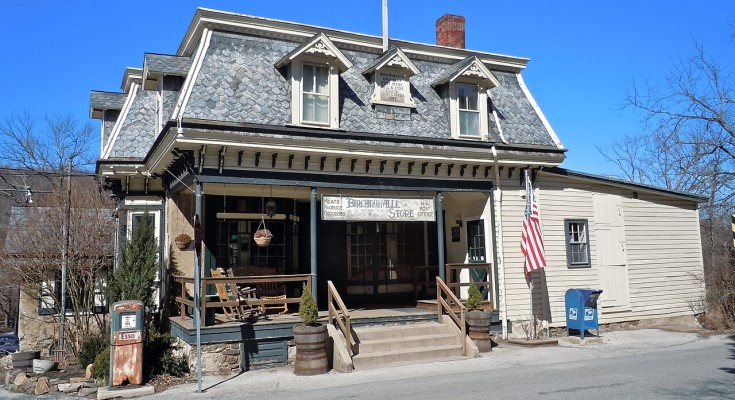
At the center of it all stands the Birchrunville General Store, its mansard roof rising slightly above the rest, its windows angled outward as if still watching the road. Built in 1898, the structure carries its history openly—wood and stone layered with purpose, not decoration. Inside, the space has shifted over time, now a small restaurant where conversation replaces commerce but the sense of gathering remains unchanged.
The room is warm, intimate. Chairs scrape lightly against the floor. Plates arrive without ceremony.
“You feel like you’re part of something here,” a diner says, lowering their voice as if the space requires it. “Not just passing through.”
That distinction—between passing through and belonging—has always defined Birchrunville.
Even at its height, the village never expanded beyond what its geography allowed. The mills operated, the store served, the schoolhouse educated, but the boundaries held. Today, with just over a hundred residents, the scale remains almost unchanged, a rarity in a region where growth often reshapes entire landscapes.
And yet, Birchrunville is not isolated.
A few miles away, the Pennsylvania Turnpike carries a different rhythm—faster, louder, more insistent. Towns like Phoenixville and Chester Springs continue to expand, drawing new residents and new expectations. But here, the transition is abrupt. One moment you are moving with the pace of the region; the next, you are stepping into something quieter.
The surrounding Nantmeal Hills reinforce that separation.
Fields and woodlands stretch outward, broken only by narrow roads and the occasional stone barn. The land rises and falls in long, deliberate movements, creating views that feel both expansive and contained. It is not untouched, but it is uninterrupted.
Even the traditions here reflect that continuity.
Each year, the Fourth of July parade moves through the village with a simplicity that resists spectacle—neighbors, families, familiar faces moving along the same roads that have held generations before them. It began in 1976, but it feels older, as if it belongs to the rhythm of the place rather than a specific moment in time.
“It’s the same every year,” the resident says, smiling slightly. “That’s the point.”
As evening settles into the hollow, the light fades more slowly than expected, lingering on the stone surfaces and the edges of the stream. The road quiets. The air cools just enough to carry the sound of water more clearly.
A car passes, slower now, almost cautious. Then another. Then none.
“It teaches you to pay attention,” the resident says, looking down toward the bridge as the last of the light slips through the trees. “You don’t rush through here. You notice where you are.”
The stream continues, steady as it has always been. The buildings hold their places. And in the space between movement and stillness, Birchrunville remains—unchanged not by resistance, but by intention, a village that has never needed to be anything other than itself.
Support the local news that supports Chester County. MyChesCo delivers reliable, fact-based reporting and essential community resources—free for everyone. If you value that, click here to become a patron today.