
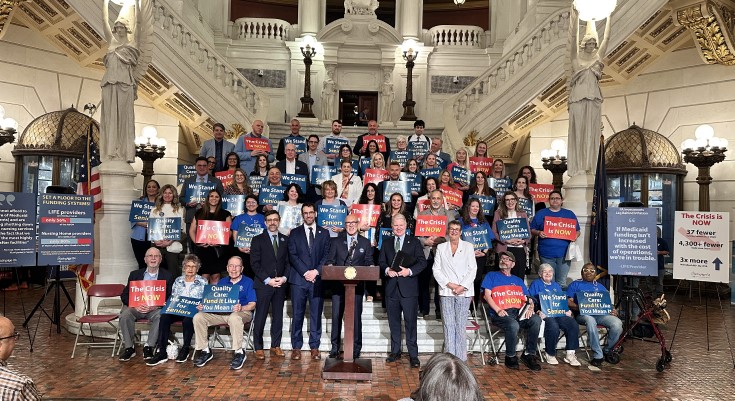
HARRISBURG, PA — Senior care providers and bipartisan lawmakers are pressing Pennsylvania policymakers to increase Medicaid support for nursing homes and home-based elder care programs, warning that demographic growth and workforce shortages are outpacing the state’s long-term care capacity.
At a rally Tuesday in the Capitol Rotunda, LeadingAge PA and participating lawmakers argued that action is needed before the June 30 expiration of a key nursing home funding mechanism, saying financial pressures have contributed to shrinking nursing home capacity across the commonwealth.
The debate comes as Pennsylvania’s population age 85 and older is projected to triple by 2050, increasing demand for long-term care, home-based services, and specialized support programs.
LeadingAge PA President and Chief Executive Officer Garry Pezzano stated that providers are seeing fewer available nursing home beds as facilities face mounting financial and staffing challenges.
“We’re losing nursing home capacity by the thousands; fewer communities, fewer beds, and most importantly, more older adults are being turned away from the high-quality care they need and deserve close to home,” Pezzano said.
A central focus of the group’s budget request is the state’s Living Independence for the Elderly, or LIFE, program, which provides comprehensive medical and support services designed to help older adults remain in their homes and communities rather than enter institutional care.
LeadingAge PA is seeking a minimum Medicaid reimbursement rate equal to 60% of the Amount That Would Otherwise Be Paid, known as AWOP, for LIFE providers. The organization estimates the proposal would require approximately $19.3 million in annual state funding.
The association is also advocating for a 0.84 floor on the Budget Adjustment Factor, or BAF, a Medicaid reimbursement mechanism used in nursing home funding formulas. The current BAF is scheduled to expire at the end of June.
State House Majority Whip Michael Schlossberg and House Aging and Older Adult Services Committee Chair Maureen Madden joined the event, arguing that continued investment in aging services is necessary as Pennsylvania’s population grows older.
Madden pointed to the LIFE program as a tool for helping seniors remain independent while reducing reliance on institutional care.
State Sen. David Argall focused on workforce shortages affecting long-term care providers, saying staffing challenges are placing increasing pressure on facilities and families.
“Too many of our families, including mine, have faced the difficult decision of moving a parent or grandparent into a long-term care center,” Argall said. “The professionals who care for them are facing increasing challenges because of workforce shortages.”
The funding requests come as lawmakers continue negotiations on Pennsylvania’s fiscal year 2026-27 budget, where Medicaid spending and long-term care funding are expected to remain key issues.
LeadingAge PA advised that failure to address reimbursement levels could further strain nursing home operators and community-based aging service providers as demand for care continues to rise.
Support the local news that supports Chester County. MyChesCo delivers reliable, fact-based reporting and essential community resources—free for everyone. If you value that, click here to become a patron today.