
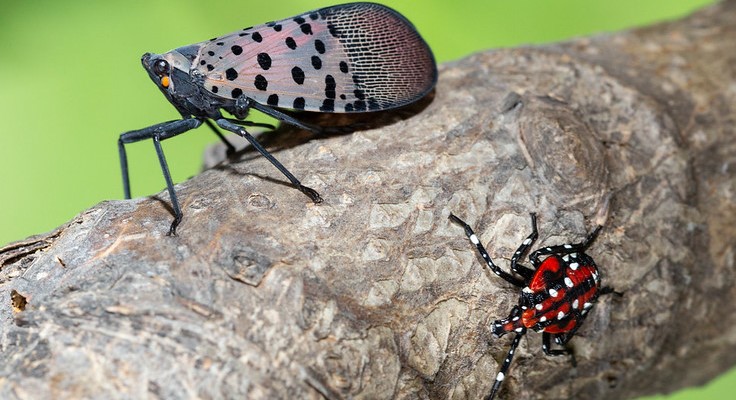
WASHINGTON, D.C. — A bipartisan group of U.S. senators has introduced legislation that would make spotted lanternflies a high-priority research focus for the National Institute of Food and Agriculture, a move aimed at strengthening federal efforts to combat an invasive pest that continues to threaten Pennsylvania’s agricultural economy.
U.S. Sens. John Fetterman (D-Pa.) and Dave McCormick (R-Pa.), joined by Sens. Ron Wyden (D-Ore.) and Kirsten Gillibrand (D-N.Y.), introduced the Spotted Lanternfly Research and Development Act, which would designate the invasive insect as a priority for federally supported research.
The legislation comes as the spotted lanternfly remains established across much of Pennsylvania. First detected in Berks County in 2014, the insect is now present in 51 counties, according to the senators’ offices. Studies cited in the announcement estimate the pest could cost Pennsylvania as much as $324 million annually if left unchecked.
“Spotted lanternflies have ravaged crops that are critical to Pennsylvania’s economy including grapevines, apples, peaches, hops, and more,” Fetterman stated. “For over a decade, they have cost the Commonwealth millions of dollars and thousands of jobs.”
McCormick characterized the measure as an investment in protecting Pennsylvania’s agricultural sector from mounting pest-related losses.
“By investing in research to combat spotted lanternflies, this bill will help protect our farms, strengthen our agricultural economy, and better control this invasive species,” McCormick stated.
According to the bill’s sponsors, the legislation would elevate spotted lanternfly research within the National Institute of Food and Agriculture, potentially directing additional federal resources toward developing methods to control the insect and reduce its economic impact.
The spotted lanternfly, Lycorma delicatula, is native to parts of Asia and is believed to have entered the United States through egg masses attached to imported stone. After its discovery in Berks County, the insect spread rapidly across Pennsylvania, aided largely by egg masses transported on vehicles, rail cars, equipment and other outdoor surfaces.
The pest feeds on a wide range of plants, including grapevines, fruit trees and hardwoods, posing risks to the state’s agriculture, nursery and timber industries. Its spread has also been aided by the widespread presence of tree-of-heaven, an invasive plant that serves as one of its preferred hosts.
Pennsylvania responded by expanding quarantine zones covering more than 50 counties and requiring businesses moving equipment and vehicles within affected areas to obtain permits and perform inspections. Public awareness campaigns have also encouraged residents to destroy lanternflies and scrape egg masses, but the insect has continued to spread into neighboring Mid-Atlantic and Midwestern states.
Support the local news that supports Chester County. MyChesCo delivers reliable, fact-based reporting and essential community resources—free for everyone. If you value that, click here to become a patron today.