
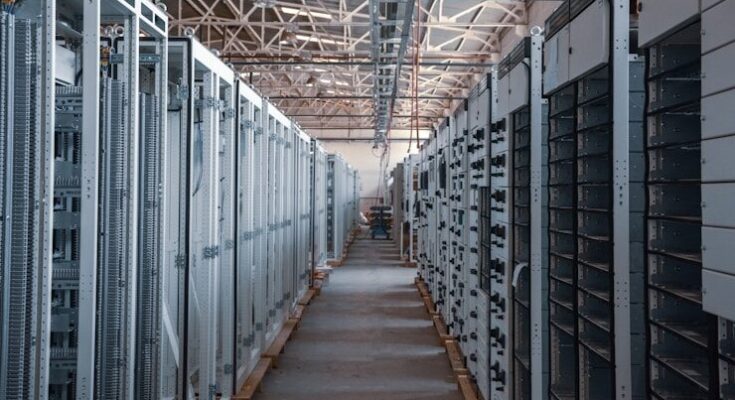
WEST CHESTER, PA — Birmingham Township supervisors will consider on Sept. 8 whether to open two commercial zoning districts to data centers under conditional-use rules that would impose restrictions on noise, water consumption, power generation, setbacks, and emergency planning, establishing a local regulatory framework for facilities with potentially intensive infrastructure demands.
The proposed ordinance would permit data centers in the Heavy Commercial (C-2) and Limited Highway Commercial (C-2A) districts only through conditional-use approval by the Board of Supervisors. No data center ordinance has been enacted.
The public hearing is scheduled for 7 p.m. Tuesday as part of the supervisors’ regular meeting. The board will consider whether to enact the amendment after the hearing, according to the township’s public notice.
Birmingham said it is pursuing the amendment because its existing zoning ordinance neither defines data centers nor identifies a district where they are allowed, leaving the township potentially vulnerable to an exclusionary-zoning challenge under Pennsylvania law. Officials said the proposal is intended to establish where such facilities could operate and what conditions would apply rather than encourage their development.
Under the draft, a data center would need at least eight net acres. Buildings, accessory uses and associated equipment generally would have to be at least 200 feet from adjoining property lines and road rights-of-way, increasing to 400 feet where the property abuts a residential use. Buildings would be limited to 35 feet, with certain rooftop equipment and parapets allowed to reach 40 feet.
Noise controls make up a substantial portion of the proposal. Applicants would have to submit a professional noise and vibration analysis before construction and another study within 180 days after operations begin, with evaluations assuming generators, cooling systems and other noise-producing equipment are operating simultaneously at maximum rated capacity.
At residential property lines, the proposed limit would be 55 dBA during daytime hours from 7 a.m. to 10 p.m. and 45 dBA overnight. Commercial and mixed-use areas would have limits of 60 dBA during the day and 50 dBA at night, while industrial limits would be 65 dBA and 55 dBA, respectively. The ordinance also establishes separate low-frequency noise standards.
If post-construction testing finds a violation, the operator would have 30 days after township notice to submit a corrective-action plan and generally no more than 90 days to remedy the problem. The township could require additional testing after substantiated complaints or equipment changes and could impose temporary operating restrictions while compliance is being addressed.
The proposal would also regulate data centers’ demands on local water and sewer systems. Facilities would have to connect to public water and sewer, document expected water consumption and demonstrate that adequate supply is available without reducing water pressure or availability for other township users. Groundwater and direct surface-water withdrawals would be prohibited.
Cooling systems would generally have to use air cooling or closed-loop liquid circulation, although the township could approve an alternative shown to consume less water and energy. Applicants would also have to submit drought-response plans.
Power demand would receive separate scrutiny. A conditional-use application would have to identify annual and peak electricity demand, supply sources, storage capacity and backup power, along with documentation of efforts to use renewable or clean energy and improve energy efficiency. Projects connecting to the grid would have to document their utility interconnection process and anticipated energization date.
Backup generators would have to meet U.S. Environmental Protection Agency Tier 4 emissions standards. Routine maintenance and readiness testing generally would be capped at 100 hours annually and restricted to 10 a.m. through 4 p.m. Monday through Friday.
The draft would prohibit using backup generators for peak shaving or routinely supplying electricity to the grid. Operators would be required to post testing schedules publicly at least 24 hours in advance and notify the township, while the ordinance also calls for backup generation to be made available to the local grid during certain prolonged community emergencies.
Independent energy systems — including battery storage, geothermal, solar, petroleum-based and nuclear generation — would be treated as part of the data center use and subject to township review. Adding such systems later could require amendment of an existing conditional-use approval.
Applicants would additionally have to submit emergency-response plans reviewed by local fire and emergency services. Operators would be responsible for specialized and continuing first-responder training costs, and battery-energy storage installations would have to demonstrate compliance with NFPA 855 or comparable standards.
The ordinance would require a decommissioning plan and financial security sufficient to cover shutdown and site restoration. Decommissioning would have to begin within one year after operations cease and be completed within 18 months.
Birmingham said it developed the proposal after reviewing guidance from the Chester County and Montgomery County planning commissions and consulting its solicitor, engineer, zoning officer and Planning Commission.
The hearing will be held at the township municipal building, 1040 West Street Road, West Chester. The draft ordinance and hearing information are available at www.birminghamtownship.org.
Support the local news that supports Chester County. MyChesCo delivers reliable, fact-based reporting and essential community resources—free for everyone. If you value that, click here to become a patron today.