
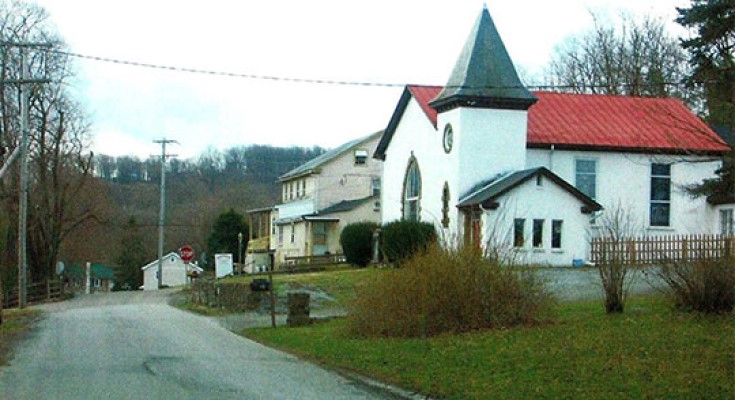
Morning arrives slowly in Nantmeal Village. A thin veil of mist hangs over the fields, softening the edges of split-rail fences and stone walls that have stood longer than most names remembered here. Along the bend where Nantmeal Road meets Fairview, the gravel crunch of a passing truck feels louder than it should, as if sound itself carries farther in a place so otherwise undisturbed. A church steeple cuts cleanly into the pale sky, and beyond it, fields roll outward in quiet succession—green, then darker green, then the dense line of woods that marks the horizon.
Nothing about Nantmeal Village demands attention. It simply holds it.
By midmorning, the stillness gives way to small, deliberate movements. A farmer checks a fence line. A car turns slowly onto Coventryville Road, tires brushing dust into the air. The buildings—stone, timber, and timeworn brick—stand close to the road in a pattern set centuries ago, their proportions unchanged, their purpose quietly adapted to modern life.
Nantmeal matters now because so little of it has been interrupted. In a county where growth has steadily reshaped open land into subdivisions and commercial corridors, this crossroads community in East Nantmeal Township remains strikingly intact—a 740-acre historic district where architecture, landscape, and roadways still reflect the rhythms of the 18th and 19th centuries. It is not preserved as a museum. It persists as a living place.
“You don’t just drive through here,” a resident says, pausing near a stretch of stone wall that borders his property. “You feel it slow you down. That’s how it’s always been.”
The village traces its roots to Welsh Quaker settlers who arrived in the early 1700s, carving farms out of rolling land that reminded them of home in Radnorshire, Wales. Families like the Merediths, Stephens, and Griffiths established not just homesteads, but a framework for community—one built around agriculture, faith, and shared labor. A Friends Meeting House stood here by 1739, long gone now, though its cemetery remains, tucked along Fairview Road, a quiet ledger of names and years.
The Abraham Prizer House, built around 1735, still stands as the village’s oldest structure. Its fieldstone walls, thick and deliberate, seem less constructed than grown from the earth itself. Nearby, a cluster of buildings tells the story of a self-sufficient crossroads: a cabinetry shop dating to 1760, a general store from 1820, a schoolhouse built in 1861. Each one speaks to a time when everything needed for daily life existed within walking distance.
“It was all here,” the resident says. “Blacksmith, store, school. You didn’t have to leave unless you wanted to.”
That sense of contained life remains embedded in the landscape. Barns sit low against the contours of the land, their weathered boards blending into the fields. Springhouses, small and purposeful, mark the locations of long-used water sources. Woodlots break up the farmland in patterns that have changed little over generations.
At the center of it all stands the Nantmeal United Methodist Church, its Gothic Revival lines rising above the village with understated grace. Built in 1852 and later remodeled, the structure anchors the crossroads both visually and socially. Its pointed windows catch the light differently throughout the day, shifting from shadowed gray in the morning to a warmer tone by late afternoon.
“It’s where people still come together,” says another local, glancing toward the church as a car slows nearby. “Not just for services. For everything.”
There are no large events that define Nantmeal Village, no festivals that draw crowds from outside. Life here unfolds in smaller gatherings—church functions, township meetings, quiet exchanges between neighbors. The absence of spectacle feels intentional, even if it isn’t.
Development has not ignored Nantmeal. It presses in from surrounding areas, where farmland gives way to new construction and commuter routes grow busier each year. Yet within the village, change feels negotiated rather than imposed.
“People care about what this place looks like,” the resident says. “Not just the buildings—the land, the spacing, the way it all fits together.”
That cohesion is what earned Nantmeal Village a place on the National Register of Historic Places in 2014, but the designation only formalized what has long been evident. The village’s significance lies not in any single structure, but in the way everything remains connected—roads following their original paths, buildings maintaining their orientation, fields still shaping the experience of moving through the space.
By late afternoon, the light begins to stretch across the landscape, pulling long shadows from barns and trees. The air cools, carrying the faint scent of earth and cut hay. A car passes through the intersection, slowing instinctively before continuing on.
For a moment, the village returns to stillness.
“It’s not about keeping things the same forever,” the resident says, watching the road empty again. “It’s about knowing what matters enough not to lose.”
As the sun dips lower, Nantmeal settles back into itself, the mist beginning to gather again at the edges of the fields. The roads remain, the houses hold their place, and the land—quiet, enduring—waits for morning to arrive just as it always has.
Support the local news that supports Chester County. MyChesCo delivers reliable, fact-based reporting and essential community resources—free for everyone. If you value that, click here to become a patron today.