
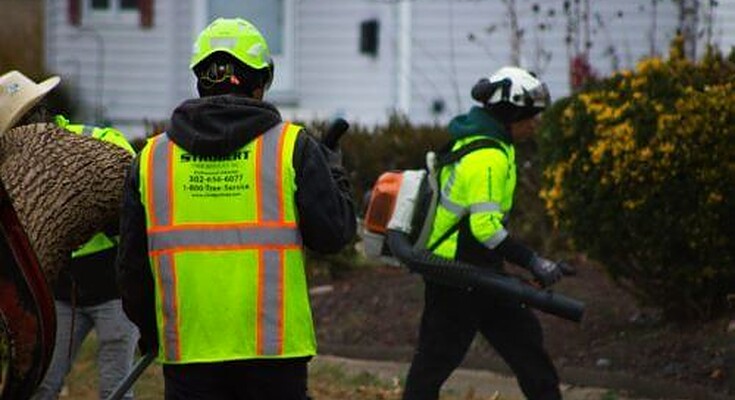
As the region heads into peak storm season, arborists are urging Chester County homeowners to look at their trees now, before high winds turn a weak limb into an emergency call.
Chester County sees severe weather from spring through fall, and the National Weather Service notes that the western half of the county often gets hit harder than the eastern half. The trees that come down are often the ones that looked healthy the day before. Heavy rain soaks the region’s clay soil, loosening the roots’ grip, and the wind does the rest.
Strobert Tree Services, an ISA Certified Arborist firm that has worked across Chester County since 2000, said most of those failures are avoidable because the trees give warning signs long before they fall.
“Most of the trees we take down after a storm were showing signs months earlier,” said Ed Goddard, director of business development at Strobert Tree Services. “A dead limb over a driveway is a small job in July. It becomes an emergency in September.”
Those signs, according to the company, include dead or hanging limbs over a roof or driveway, cracks or cavities in the trunk, mushrooms or hard shelf-like fungus at the base, soil heaving on one side of the root plate, a lean that is new or getting worse, and any tree that dropped a large limb in a past storm and was never checked.
Not every damaged tree needs to come down. Trees with more than about two-thirds of their canopy intact, along with a sound trunk and main leader, will often recover, and younger trees usually bounce back more quickly than the large oaks and maples common in many of the county’s older neighborhoods. Removal is more likely when a trunk splits, more than half the canopy is gone, the main leader snaps, roots lift, or decay has started. The trickiest cases are often the ones that are still standing, the company said, because cracked joints or hidden rot can be hard to spot from the ground and are often what gives way in the next storm.
The question that surprises homeowners most is who pays. In most cases, homeowners’ insurance covers the removal of a tree only after it falls on a covered structure, such as a house, garage, or fence, during a covered event like a windstorm, and policies often cap that assistance at around $500 to $1,000 per tree. A healthy tree that falls in the yard and hits nothing is usually not covered. Removing a risky tree before it falls is usually not covered by insurance. And when a neighbor’s tree falls onto a property, the affected homeowner’s insurer typically handles the damage, not the neighbor’s insurer, unless the neighbor was warned in writing about the hazard and did nothing. Policies vary, and homeowners should check their coverage.
Storm cleanup can be dangerous. Downed wires should always be treated as live and reported to PECO, which serves most of the county, and broken limbs caught in the canopy can fall without warning.
READ: After Massive Blackouts, Pennsylvania Maps a New Playbook for Storm Survival
Arborists caution homeowners not to use a chainsaw above shoulder height or from a ladder, and to call a professional for any tree near power lines, leaning, partly uprooted, or showing signs of decay. When hiring, the company and industry groups recommend checking that ISA Certified Arborists are on staff, requesting proof of liability and workers’ compensation insurance, and obtaining two written estimates before the work begins.
Homeowners can look up and verify a certified arborist through the International Society of Arboriculture’s free Find an Arborist tool, and track approaching storms on MyChesCo’s Chester County weather page.
Support the local news that supports Chester County. MyChesCo delivers reliable, fact-based reporting and essential community resources—free for everyone. If you value that, click here to become a patron today.