
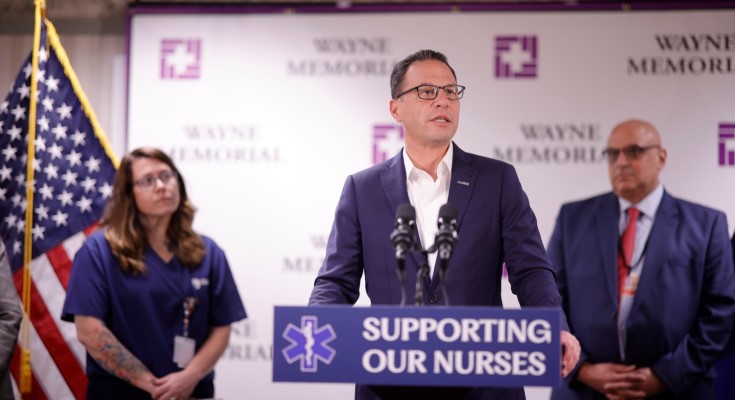
HONESDALE, PA — Pennsylvania is offering nursing students up to $20,000 annually in combined state and employer loan repayment assistance under a $5 million program launched Tuesday, October 13, as hospitals confront a 15% nursing vacancy rate and a projected statewide shortage of 22,000 nurses by 2028.
Gov. Josh Shapiro and Health Secretary Dr. Debra Bogen launched the Nurse Shortage Assistance Program at Wayne Memorial Hospital in Wayne County, establishing a financial incentive for nursing students who commit to working at participating Pennsylvania hospitals after graduation.
The initiative, funded through the state’s 2026-27 budget, provides up to $10,000 annually in state loan repayment assistance. Participating hospitals must match the state contribution dollar for dollar, potentially doubling the benefit to $20,000 per recipient each year.
Students must be pursuing a nursing degree and agree to a three-year employment commitment at a participating hospital after graduation.
The Pennsylvania Higher Education Assistance Agency will distribute the funding through Scholars Network, the program’s servicing partner. State officials estimate that up to 200 nursing students could receive assistance during the first year.
The program addresses a workforce shortage that has increased staffing pressure on Pennsylvania hospitals. According to the Hospital and Healthsystem Association of Pennsylvania, an average of 15% of licensed nursing positions at hospitals statewide remain vacant.
The shortage is projected to reach 22,000 nurses by 2028, raising concerns about hospitals’ ability to maintain staffing levels and meet patient demand.
“By expanding education programs, providing tuition assistance, and connecting nursing students with hospitals, we can ensure there are enough skilled professionals in our communities to deliver high-quality patient care,” Shapiro said.
Wayne Memorial Hospital illustrates the staffing challenges confronting rural health systems. The hospital reports a 25% vacancy rate across its full-time and part-time registered nurse and licensed practical nurse positions, substantially exceeding the statewide average.
Its parent organization, Wayne Memorial Health System, serves more than 100,000 residents annually across Wayne and Pike counties and surrounding communities.
Hospital officials expect participation in the program, combined with partnerships with universities, to support recruitment and retention.
“The nursing shortage is a serious national and local challenge that affects patients, families, and healthcare organizations across the country. There’s no single cause and no quick fix,” said Chandra Roberts, the health system’s chief nursing and patient care services officer.
Roberts identified expanded nursing education, clinical placements, workplace safety, competitive compensation and mentorship as additional measures needed to address staffing shortages.
The statewide program builds on an earlier pilot that provided loan repayment assistance to nursing students who committed to participating health systems.
Jamie Wagner, a pilot participant from Bradford County, became a registered nurse in 2025 and now works for Guthrie Health System. She is receiving loan repayment assistance and is expected to have her student loans fully repaid by December 2027.
The initiative is part of a broader state effort to expand Pennsylvania’s health care workforce.
The Shapiro administration has implemented interstate licensing compacts allowing eligible health professionals licensed in other participating states to practice in Pennsylvania. The nursing compact includes more than 40 other states.
Pennsylvania has also reduced professional licensing processing times. Between 2023 and 2025, the average processing time for nursing licenses fell from 25 days to six days, according to the administration.
Other measures include restrictions on certain health care noncompete agreements under the Fair Contracting for Health Care Practitioners Act and more than $40 million in loan repayment assistance for nearly 590 substance use disorder treatment and recovery professionals.
The new nursing program links financial assistance directly to employment commitments, giving participating hospitals a recruitment mechanism while reducing education-related debt for prospective nurses.
Its effectiveness will depend on whether the incentives attract nursing graduates to hospitals facing persistent vacancies and help retain them after their required service commitments end.
Support the local news that supports Chester County. MyChesCo delivers reliable, fact-based reporting and essential community resources—free for everyone. If you value that, click here to become a patron today.