
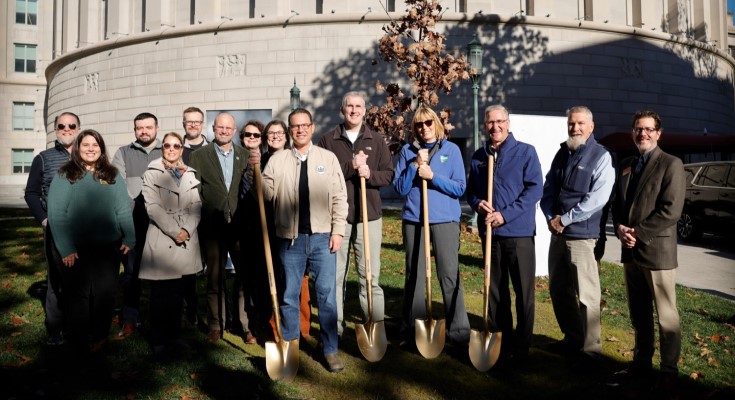
HARRISBURG, PA — Pennsylvania has planted more than 5.4 million trees toward its goal of 34 million by 2033, leaving roughly 28.6 million still to be planted as Gov. Josh Shapiro marked progress Thursday, November 19, on a broader conservation initiative spanning eight U.S. states and two Canadian provinces.
The Great Lakes St. Lawrence Governors & Premiers, a regional organization chaired by Shapiro, reported that its members have planted 57 million trees over the past two years toward a collective target of 250 million by 2033.
That represents approximately 23% of the regional goal, with 193 million additional trees needed to meet the commitment.
Pennsylvania has reached approximately 16% of its statewide target, based on figures released by the governor’s office.
The Commonwealth planted approximately 2.7 million trees in 2024 and 2.75 million in 2025. Meeting the remaining commitment will require substantially higher annual planting totals than those recorded in either year.
Shapiro joined Department of Conservation and Natural Resources Secretary Cindy Adams Dunn, Agriculture Secretary Russell Redding and representatives of the Great Lakes St. Lawrence Governors & Premiers at the State Capitol Complex in Harrisburg on Thursday to plant a red oak commemorating the regional initiative.
The event highlighted a conservation program intended to improve water quality, reduce flooding, restore wildlife habitat and support agricultural land management across the Great Lakes region.
Pennsylvania’s participation extends beyond its Lake Erie watershed to conservation projects throughout the state, including reforestation, urban tree planting, watershed restoration and abandoned mine land reclamation.
The administration is incorporating existing state and local conservation programs into the planting effort rather than relying on a single statewide project.
Those programs include Chesapeake Bay watershed restoration, urban and community forestry initiatives, the Pennsylvania Invasive Replace-ive Program, abandoned mine reclamation and projects supported through Community Conservation Partnership Program grants.
State agencies are also working with nonprofit organizations, private landowners, conservation groups and local governments to increase planting activity.
One significant expansion involves DCNR’s Mira Lloyd Dock Resource Conservation Center, where annual seedling production capacity has doubled from approximately 1 million to 2 million seedlings.
The increased production is intended to support reforestation, habitat restoration and community forestry projects as Pennsylvania works toward its 2033 target.
“Every tree planted helps improve water quality, restore wildlife habitat, reduce flooding, capture carbon, and make our communities healthier and more resilient,” Dunn said.
The environmental objectives carry implications for Pennsylvania’s agricultural economy, particularly where tree planting can help reduce soil erosion, protect waterways and provide habitat for pollinators.
The administration’s Strategic Plan for Agriculture identifies environmental stewardship, soil health and water quality as priorities alongside research, technical assistance and agricultural innovation.
Through the Great Lakes St. Lawrence Sustainable Agriculture Initiative, Pennsylvania is participating in efforts to connect agricultural research with practical applications and encourage the adoption of technologies intended to protect natural resources.
“Agriculture doesn’t stop at state or national lines, and neither should our efforts to support it,” Redding said.
“We have an opportunity to learn from one another, share what works, and bring together the research, resources, and innovation our farmers need to succeed.”
The regional tree-planting program is also part of a broader effort to strengthen economic and environmental cooperation between U.S. states and Canadian provinces.
As chair of the Great Lakes St. Lawrence Governors & Premiers, Shapiro has advocated closer coordination on regional economic development, shared waterways and cross-border priorities.
The governor signed a memorandum of understanding with Ontario this year, traveled to Toronto for the U.S.-Canada Summit and met with senior officials in Canada’s federal government.
David Naftzger, executive director of the Great Lakes St. Lawrence Governors & Premiers, said cooperation among participating governments and conservation organizations is central to meeting the regional planting commitment.
“Through the Great Lakes St. Lawrence Trees Initiative, states and provinces are working together to plant 250 million trees by 2033,” Naftzger said.
The governor’s office reported that 30 million of the 57 million trees planted regionally were added during Shapiro’s leadership of the organization.
“Three years ago, the Great Lakes St. Lawrence Governors & Premiers set an ambitious goal, and so far, we are making significant progress towards accomplishing that goal as we have planted more than 57 million trees in just two years,” Shapiro said.
Pennsylvania’s Department of Environmental Protection is also involved in conservation efforts intended to protect drinking water supplies, improve air quality and reduce environmental damage through forest buffers and additional tree cover.
The state’s conservation strategy includes planting trees along waterways to intercept runoff, stabilize soil and support water quality improvement.
The regional partnership’s next Leadership Summit is scheduled for 2027 in Erie, bringing governors, premiers and other officials to Pennsylvania to address shared economic and environmental priorities.
With seven years remaining until the 2033 deadline, Pennsylvania and its regional partners face the challenge of accelerating planting activity while maintaining the conservation programs and partnerships needed to meet their commitments.
Support the local news that supports Chester County. MyChesCo delivers reliable, fact-based reporting and essential community resources—free for everyone. If you value that, click here to become a patron today.