
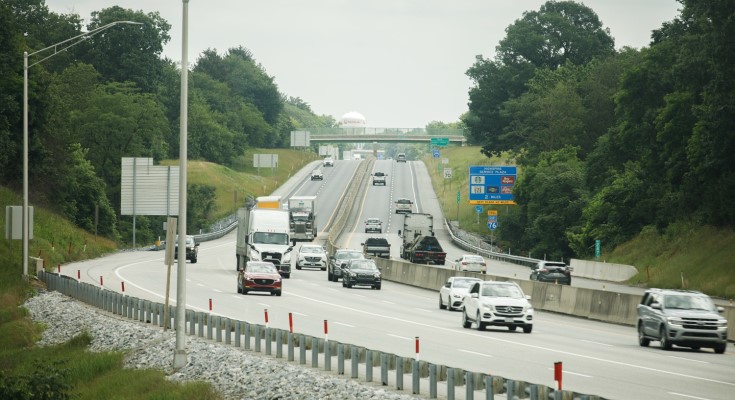
MIDDLETOWN, PA — The Pennsylvania Turnpike Commission has earned a perfect score on the state’s annual sustainability assessment for the fifth consecutive year, becoming the only Pennsylvania agency to maintain that record as it expands electric vehicle charging infrastructure, renewable energy installations and operating efficiency measures across the toll highway system.
The commission met all applicable standards in the Pennsylvania GreenGov Council’s Agency Certification Checklist, which evaluates state agencies on approximately 100 sustainability measures across 20 categories.
The assessment covers energy consumption, vehicle fleet efficiency, procurement practices, operational policies and employee engagement. Among its benchmarks is a 3% reduction in energy consumption.
Established in 2019, the GreenGov Council operates within the Pennsylvania Department of Environmental Protection and supports the state’s goal of reducing net greenhouse gas emissions 80% below 2005 levels by 2050.
The commission’s fifth consecutive perfect score reflects its implementation of sustainability practices across highway operations, maintenance facilities and administrative properties.
Among its most significant infrastructure initiatives is the expansion of electric vehicle charging facilities along the Pennsylvania Turnpike.
The commission currently offers more than 100 EV chargers across its system and plans to install fast-charging equipment at all 17 Turnpike service plazas by early 2027.
The expansion is intended to improve charging availability for motorists traveling longer distances on the toll road, supporting the transition toward electric vehicles.
The commission is also investing in distributed energy infrastructure to support its operations.
Solar microgrids have been constructed at the Greensburg District Maintenance Shed and Western Regional Office. Both installations incorporate backup natural gas generators, providing an additional source of electricity when needed.
Additional solar arrays are planned, while construction is underway on a solar canopy at the commission’s Central Administration Building in Middletown.
The energy projects are part of a broader effort to reduce electricity consumption and operating expenses. The commission said its energy conservation measures have already generated financial savings.
Beyond energy infrastructure, the agency has modified highway maintenance practices to support environmental conservation.
Reduced mowing schedules allow native vegetation to grow in selected areas, while pollinator habitats have been established at seven locations, including service plazas, interchanges and the Middletown administration building.
The commission is evaluating more than 50 additional sites for potential pollinator habitat installations.
These measures integrate vegetation management and habitat conservation into the operation of the highway system.
The commission has also introduced a Sustainability Impact Award to recognize employees contributing to environmental and operational improvements.
Kathryn Hartzell, the commission’s assistant chief technology officer and sustainability committee co-chair, said the agency’s efforts are tied to its longer-term infrastructure strategy.
“All of our work is leading us down the road to achieving our ultimate goal of becoming America’s First Sustainable Superhighway by 2040,” Hartzell said.
That objective is incorporated into the commission’s Vision 2040 Roadmap, which guides sustainability initiatives across transportation infrastructure, facilities and operations.
The roadmap connects environmental objectives with operational efficiency and long-term financial management, including efforts to reduce energy costs and modernize supporting infrastructure.
Leslie Gervasio, the commission’s director of communications and sustainability committee co-chair, said the strategy is intended to strengthen operations while supporting environmental goals.
“This roadmap builds on the work already underway across the Commission, positioning us as an industry leader in sustainable practices that protect our environment, strengthen our operations and support long-term financial sustainability,” Gervasio said.
The GreenGov certification measures compliance with established sustainability standards rather than the commission’s overall progress toward its 2040 objectives.
The latest assessment nevertheless extends the agency’s record of meeting every applicable state certification requirement while pursuing infrastructure improvements intended to reduce operating costs and support changing transportation needs.
Support the local news that supports Chester County. MyChesCo delivers reliable, fact-based reporting and essential community resources—free for everyone. If you value that, click here to become a patron today.