
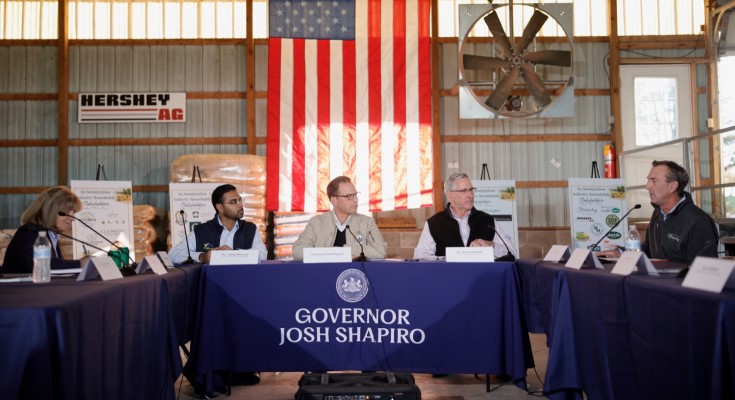
MARIETTA, PA — More than 1,000 employees of Pennsylvania agricultural businesses have lost legal immigration protections following federal policy changes, industry representatives told Gov. Josh Shapiro on Thursday, November 19, as farmers warned that intensified immigration enforcement is disrupting food production and threatening operations across a sector contributing $132.5 billion to the state’s economy.
Shapiro and Agriculture Secretary Russell Redding met with farmers, agricultural employers and industry organizations at Hershey Ag in Lancaster County to discuss workforce losses linked to U.S. Immigration and Customs Enforcement activity and changes to federal immigration programs.
The meeting, organized by PennAg Industries Association, followed a letter from 32 agricultural organizations and employers urging federal officials to address enforcement practices that businesses say are destabilizing their operations.
According to the governor’s office, more than 1,000 employees of companies represented at the roundtable have lost legal status protections because of changes involving Temporary Protected Status, visas and other immigration pathways.
The disruptions have been particularly significant for mushroom growers and poultry producers, where labor shortages can affect harvesting, animal care and processing schedules.
Pennsylvania has nearly 48,800 farms, and its agricultural industry supports approximately 600,000 jobs, according to figures cited by the administration.
The industry’s dependence on immigrant labor extends across dairy farming, poultry production, mushroom cultivation, fruit harvesting, livestock operations and food processing.
Agricultural employers said abrupt workforce losses create operational problems that cannot always be resolved by delaying production or reallocating employees.
Livestock require daily care, crops must be harvested within specific periods, and processing facilities depend on predictable staffing to maintain production schedules.
“When workers are afraid to come to work, or employers don’t know whether they can count on the people caring for their animals, harvesting their crops, and processing their products, the consequences reach far beyond the farm,” Redding said.
The workforce concerns extend beyond employees whose immigration protections have changed.
In their letter to U.S. Agriculture Secretary Brooke Rollins and Homeland Security Secretary Markwayne Mullin, agricultural organizations said some employees with legal immigration status had been detained during enforcement operations.
The organizations also reported that other legally authorized workers had missed work because they feared encounters with immigration authorities.
Sarah Zost, president of the State Horticultural Association of Pennsylvania and a fourth-generation fruit grower, described the consequences for farms that depend on seasonal agricultural employees.
“Our farm, along with several others, have had local workers detained and deported after traffic stops during their morning commute,” Zost said.
She said the uncertainty has affected employees participating in the federal H-2A agricultural visa program, which allows qualifying employers to hire foreign workers for temporary agricultural jobs.
“There’s a culture of fear and concern because you get targeted because of what you look like,” Zost said, adding that workers sometimes remain home regardless of their immigration status.
The impact on individual businesses was illustrated by testimony from Astin Melhorn, president of Paragon Poultry Management Group.
Melhorn said ICE agents stopped three company vans during August and September while employees were traveling from company housing to a poultry facility.
The encounters resulted in the loss of 17 workers, including some who held work permits, according to Melhorn.
He said some employees were transported as far as Oklahoma before being released and having to arrange their own transportation back to Pennsylvania.
“That has very much rocked our world and our industry,” Melhorn said.
Melhorn also said his company had cooperated with immigration authorities and previously communicated its willingness to assist with valid warrants.
His account illustrates the concerns agricultural employers raised about the predictability of federal enforcement and its effects on businesses attempting to maintain staffing and comply with legal requirements.
Brent Hershey, owner and president of Hershey Ag, said agricultural production systems are increasingly efficient but remain highly dependent on workers performing time-sensitive tasks.
“We’re happy with secure borders, but we need a program that we can follow, and that program needs to be honored,” Hershey said.
The employers’ concerns have prompted calls for changes to federal immigration policy that would preserve border security while providing reliable legal pathways for agricultural workers.
Shapiro criticized the Trump administration’s enforcement approach and called for comprehensive immigration legislation developed with input from agricultural businesses.
“It is clear that this nation needs comprehensive immigration reform that works with our farmers, not against them,” Shapiro said.
The governor said his administration has urged Pennsylvania’s congressional delegation and federal officials to address the industry’s labor requirements while maintaining border security.
The position reflects a broader concern among agricultural employers that existing immigration programs do not provide sufficient workforce stability for businesses whose production cycles depend on continuous staffing.
Chris Herr, president of PennAg Industries Association, said the organization had discussed the issue with Shapiro in September and sought further engagement with state and federal officials.
“We want a secure border — mission accomplished — we’re happy about that, but we also believe it’s important that Congress and the Administration in Washington fix this problem,” Herr said.
Participants also called for immigration enforcement to prioritize individuals considered dangerous criminals while ensuring lawful procedures, transparency and communication with affected employers.
The governor’s office said Pennsylvania State Police and Commonwealth agencies do not conduct immigration enforcement.
The administration has taken several steps addressing agricultural workforce needs, although federal immigration law and enforcement remain outside state control.
In February 2025, Shapiro signed legislation allowing lawful permanent residents to qualify as certified poultry technicians after completing a state-administered training course.
The change expanded eligibility for positions requiring specialized training in poultry operations.
In July 2026, the administration confirmed that the federal government would not proceed with proposed ICE detention centers in Berks and Schuylkill counties following administrative orders issued by the Pennsylvania Department of Environmental Protection.
The Department of Agriculture also released a Strategic Plan for Agriculture in October that identifies workforce development and recruitment as priorities for maintaining the industry’s economic competitiveness.
Pennsylvania has developed multilingual resources explaining legal rights and continues consulting immigrant advocates, service providers and local officials about changes in federal immigration policy.
State Sen. Judith Schwank, the Democratic chair of the Senate Agriculture and Rural Affairs Committee, said agricultural workforce disruptions carry economic consequences beyond individual farms.
“Disruptions to our agricultural workforce are costly for our farmers and for the entire Commonwealth,” Schwank said.
“Like every sector of our economy, agriculture depends on a reliable workforce.”
The roundtable highlighted a conflict between federal immigration enforcement priorities and the labor requirements of Pennsylvania’s agricultural industry.
For farmers and food processors, the immediate concern is maintaining enough workers to sustain production while federal decisions involving immigration status, work authorization and enforcement continue to affect their employees.
The industry’s representatives are seeking federal policy changes that would provide more predictable access to agricultural labor, arguing that workforce stability is essential to maintaining production, protecting farm operations and supporting the broader food supply.
Support the local news that supports Chester County. MyChesCo delivers reliable, fact-based reporting and essential community resources—free for everyone. If you value that, click here to become a patron today.