
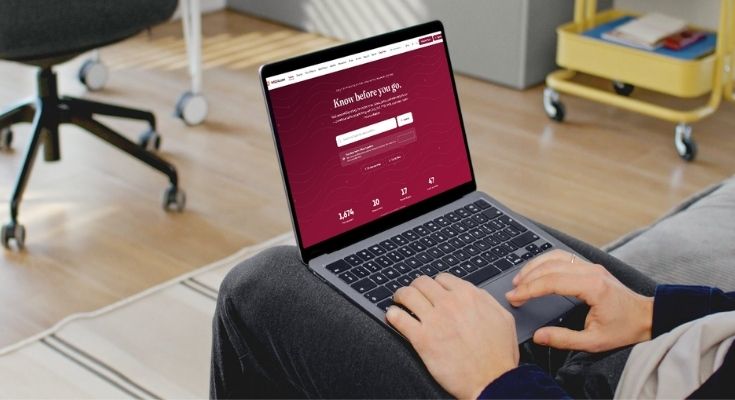
CHESTER SPRINGS, PA — A 17-year-old Downingtown East High School senior has developed a free accessibility database covering more than 1,674 locations, including approximately 900 in Chester County and the surrounding region, to help families affected by ALS and other neurological conditions determine whether public places can accommodate their needs.
Tejas Karusala, a Chester Springs resident, created MND Access after watching his grandmother, Ratnalu, lose access to familiar destinations following her diagnosis with amyotrophic lateral sclerosis, or ALS, a progressive neurological disease that affects muscle control.
The website, mndaccess.org, provides information about physical accessibility and environmental conditions at restaurants, medical facilities, and other locations. Unlike conventional accessibility listings, it allows users to prioritize information according to their medical condition.
Karusala’s grandmother gradually stopped visiting her temple, favorite restaurant, and neighborhood park because the family could not reliably determine whether those locations could accommodate her wheelchair and other needs.
“The moment it really hit me was when we tried to visit a restaurant and realized that, despite its accessibility sign, the path was too narrow for her wheelchair,” Karusala recalled.
He began developing MND Access to address the limitations of general accessibility designations, which often provide little information about door clearance, restroom configurations, or other features that can determine whether a visit is practical.
The platform evaluates locations using seven criteria: wheelchair access, bathroom accessibility, ease of opening doors, hallway width, parking, noise, and lighting.
Users can select a medical condition to change how accessibility information is prioritized.
For people with ALS, that may mean emphasizing wheelchair transfer space and access to electrical outlets for medical equipment. Families affected by frontotemporal dementia, or FTD, may place greater importance on noise levels and quieter environments.
The website is also available in Spanish.
Karusala developed the initial version independently using JavaScript and React, with Vercel for deployment and Supabase for authentication. The first version took approximately one month to complete.
The database initially contained 64 locations with fully verified accessibility information. It has since expanded to more than 1,674 listings, although newer entries may contain incomplete information.
The original locations underwent checks of every accessibility feature. As the database expanded, the platform began relying on community contributions to supplement and update listings.
Users can submit accessibility information, provide positive or negative assessments, and flag outdated entries for correction.
Approximately 900 listings cover Chester County and nearby communities, where Karusala has concentrated the project’s initial development. Penn Medicine Exton is among the local facilities included.
The expansion introduces a challenge for the platform: maintaining consistent and accurate information as the number of locations grows.
Karusala plans to address that through student-led chapters that would conduct in-person accessibility assessments at local businesses and public facilities.
Under the proposed program, high school and college volunteers would follow a standardized guide for evaluating the seven accessibility features, document their findings, and receive credit for volunteer hours.
The program would also include a national leaderboard tracking chapter participation.
No chapters are operating yet. Karusala is launching the initiative and intends to establish the first chapter in Chester County.
He has also begun contacting local businesses, with the goal of identifying specific accessibility barriers that operators could address.
“When we flag a barrier, a business gets a specific thing to fix, which is a lot easier to act on than a vague complaint,” Karusala explained.
The project remains free to use, without advertising or paid business listings.
His longer-term plans include expanding the database nationally, adding support for more medical conditions and developing partnerships with accessibility and ALS organizations.
He also hopes community participation will increase the number of locations with complete, verified information.
For his family, the project grew from the difficulty of planning ordinary outings when accessibility details were unavailable or unreliable.
“If someone had just written this down, she could have kept going,” Karusala reflected, referring to the places his grandmother stopped visiting.
Chester County residents can contribute by adding locations, reviewing existing listings, or participating in the planned student volunteer program through mndaccess.org.
Karusala hopes the project also encourages other students to develop practical solutions to problems they encounter.
“If you see something broken up close, that closeness is an advantage,” he advised. “Just start building.”
Support the local news that supports Chester County. MyChesCo delivers reliable, fact-based reporting and essential community resources—free for everyone. If you value that, click here to become a patron today.