
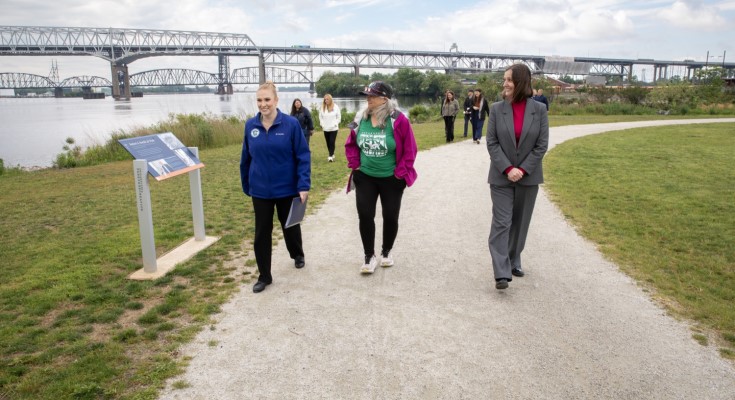
PHILADELPHIA, PA — A former industrial site along the Delaware River that once handled oil, concrete, and asphalt production has been transformed into a public waterfront park after years of environmental cleanup and redevelopment work supported by Pennsylvania’s Hazardous Sites Cleanup Act program.
What This Means for You
- A formerly contaminated industrial property is now open as a public riverfront park in Philadelphia.
- State-funded environmental cleanup efforts made the redevelopment possible.
- Governor Josh Shapiro is proposing $20 million to help stabilize Pennsylvania’s hazardous site cleanup program.
Pennsylvania Department of Environmental Protection Secretary Jessica Shirley joined local officials Thursday at the newly renamed Robert A. Borski Jr. Park in Bridesburg to highlight the project as an example of how Pennsylvania’s Act 2 Land Recycling Program can convert polluted industrial land into usable public space.
Act 2, formally known as Pennsylvania’s Land Recycling Program, is the state’s voluntary cleanup system that allows contaminated industrial or commercial properties — often called “brownfields” — to be cleaned and redeveloped under state environmental standards.
DEP officials noted technical reviews for the project were conducted by staff funded through the Hazardous Sites Cleanup Act, commonly called HSCA. The state program supports investigations and cleanup work at polluted sites when responsible parties cannot be identified or compelled to pay for remediation.
“The Robert A. Borski Jr. Park represents a powerful example of transforming Pennsylvania’s industrial legacy into a community asset and a safe space for residents to enjoy,” Shirley said.
From Industrial Property to Public Park
According to DEP, the 10-acre site operated as an oil manufacturing facility during the early 1900s before later becoming a concrete and asphalt production facility. State officials indicated industrial materials were processed onsite for decades, with residual concrete reportedly washed from trucks into the Delaware River.
The property was abandoned in the late 1980s before being acquired by the City of Philadelphia through the Philadelphia Authority for Industrial Development in 2000. City officials later began planning to convert the land into public recreational space.
DEP received a formal Notice of Intent to Remediate from Philadelphia Parks & Recreation in September 2018, launching the cleanup and environmental review process.
State officials described the redevelopment as requiring “careful planning, scientific evaluation, and targeted cleanup” to make the site safe for public use.
Cleanup Work and Environmental Improvements
Cleanup activities included removing contaminated soil, excavating lead-impacted areas that exceeded health standards, transporting hazardous material to licensed disposal facilities, installing clean soil caps more than two feet thick in some areas, and placing impermeable liners beneath stormwater infrastructure.
DEP reported the site now meets Pennsylvania environmental standards for public use. Redevelopment work added walking trails, green space, stormwater management improvements, habitat restoration, native vegetation, and public access to the Delaware River.
Riverfront North Partnership Executive Director Stephanie Phillips credited the cleanup program with restoring community access to the waterfront.
“Borski Park would not be possible without the Hazardous Site Cleanup Program,” Phillips said. “It has brought the riverfront back to life.”
Philadelphia Health Commissioner Dr. Palak Raval-Nelson described the transformation as a major quality-of-life improvement for nearby residents.
“Years ago, this was a brownfield that was so overgrown and polluted you couldn’t see the river,” Raval-Nelson said. “Today, though, Robert A. Borski, Jr. Park is a beautiful park that gives residents access to fresh air, spaces to move their bodies joyfully, and places where they can be part of the community.”
Funding Debate Continues
The announcement also highlighted Governor Josh Shapiro’s proposal to transfer $20 million in the 2026-27 state budget to stabilize the Hazardous Sites Cleanup Act program while lawmakers consider long-term funding options.
DEP officials explained the HSCA program conducts investigations into land and water pollution and helps fund cleanup work when responsible parties cannot be located. The agency added the program has supported 13,688 approved cleanups across Pennsylvania’s 67 counties since 1995 through the Act 2 redevelopment system.
Support the local news that supports Chester County. MyChesCo delivers reliable, fact-based reporting and essential community resources—free for everyone. If you value that, click here to become a patron today.