
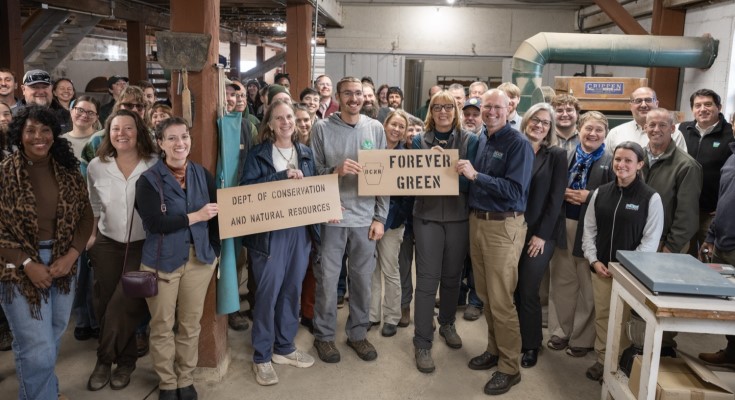
SPRING MILLS, PA — Pennsylvania’s Department of Conservation and Natural Resources unveiled a climate action plan Tuesday, Nov. 10, targeting an 80% reduction in agency greenhouse gas emissions by 2050 while preparing the state’s 125 parks and 2.2 million acres of forestland for increasingly severe weather and other climate-related risks.
DCNR Secretary Cindy Adams Dunn introduced the plan at the Mira Lloyd Dock Resource Conservation Center in Centre County, outlining new requirements for energy use, infrastructure planning, land management and climate preparedness across the agency’s operations.
The 182-page plan establishes 60 measurable climate goals and 49 bureau-level actions, with annual progress reporting intended to track implementation through 2050.
Among its principal targets, DCNR aims to generate or offset all electricity used by the department through carbon-free sources by 2035. The agency also intends to provide general and specialized climate training to all employees by 2030.
The initiative responds to changing environmental conditions across Pennsylvania, including increased flooding, extreme heat, harmful algal blooms and shifting seasonal patterns that threaten recreational facilities, ecosystems and public safety.
“Pennsylvania’s state parks and forests are among our greatest natural resources, and we have a responsibility to protect them for generations to come,” Dunn stated.
The plan incorporates findings from the Pennsylvania Department of Environmental Protection’s Climate Change Impact Assessment, including updated climate projections and a department-wide assessment of vulnerabilities.
It also includes DCNR’s first greenhouse gas inventory, establishing a basis for measuring emissions reductions and evaluating future operational changes.
The department will use the findings to guide infrastructure improvements, forest management, recreation planning and emergency preparedness.
Climate adaptation measures include strengthening trails and recreational facilities against severe storms, improving wildfire prevention, controlling invasive species and expanding emergency response training.
The strategy also addresses carbon sequestration and the use of emerging technologies in conservation and facility management.
DCNR has already installed 40 small-scale solar arrays, added more than 50 public electric vehicle charging stations and constructed 18 buildings certified under the Leadership in Energy and Environmental Design program.
Approximately 10% of the department’s vehicle fleet has been converted to electric or hybrid models.
Infrastructure improvements include the reconstructed aqueduct at Delaware Canal State Park, which was engineered to withstand future storm events.
The department also serves as Pennsylvania’s lead wildfire response agency and provides grants to volunteer fire departments for equipment and training.
Beyond state-owned property, the plan is intended to help local governments, school districts, universities and conservation organizations evaluate climate risks and develop more resilient infrastructure.
Its regional projections and land management guidance address threats including flooding, landslides and extreme heat, potentially informing decisions about municipal parks, trails and other public facilities.
The initiative builds on existing state conservation spending, including a recent $81 million investment in community projects through DCNR’s Community Conservation Partnership Program.
Since Gov. Josh Shapiro took office, his administration has invested approximately $315 million in more than 1,100 park and recreation projects across Pennsylvania.
Private landowners will also play a role in the state’s adaptation efforts. More than 70% of Pennsylvania’s forests are privately owned, making landowner participation significant to forest management and long-term ecological resilience.
DCNR provides technical assistance through county-based service foresters, advising property owners and forest managers on sustainable forestry, wildlife habitat, water protection and climate-related risks.
DEP Secretary Jessica Shirley described the plan as a framework for adapting public lands to changing conditions while preserving their recreational and environmental functions.
“As DCNR uses the plan to guide future actions, it will allow them to mitigate and adapt our public lands,” Shirley stated.
The plan also received support from conservation organizations, including The Nature Conservancy, WeConservePA and PennEnvironment, as well as Prepare PA, which identified opportunities to apply Penn State’s research and outreach capabilities to implementation.
The announcement took place at the Mira Lloyd Dock Resource Conservation Center, a facility established as a forest nursery in 1908 that now supports statewide reforestation and conservation activities.
The center collects native seeds, grows trees and shrubs for restoration projects and works with researchers on forest health. Its woodshop and sign shop also produce materials used throughout Pennsylvania’s state parks and forests.
DCNR will report annually on progress toward its climate targets, providing a continuing measure of how the department is adapting its facilities and land management practices while reducing operational emissions.
Support the local news that supports Chester County. MyChesCo delivers reliable, fact-based reporting and essential community resources—free for everyone. If you value that, click here to become a patron today.