
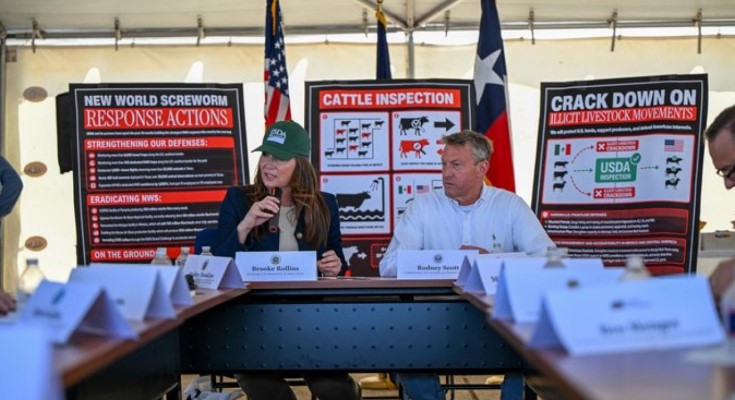
WASHINGTON, D.C. — The U.S. Department of Agriculture and Department of Homeland Security formalized a broader border biosecurity partnership last week, expanding surveillance, information sharing and joint response capabilities as federal officials work to prevent New World screwworm and other agricultural threats from reaching U.S. livestock and food systems.
Agriculture Secretary Brooke L. Rollins unveiled the memorandum of understanding at Moore Air Base in Texas, where USDA is developing sterile-fly production capacity as part of its screwworm response. U.S. Customs and Border Protection Commissioner Rodney Scott represented Homeland Security Secretary Markwayne Mullin at the event.
The agreement gives the agencies a framework for combining USDA’s animal and plant health expertise with DHS border enforcement and inspection capabilities. It calls for greater use of technologies including artificial intelligence and unmanned aircraft systems to detect and intercept agricultural threats at ports of entry and within border enforcement zones.
USDA and DHS will also exchange biosurveillance information in real time, conduct joint training and establish protocols defining each department’s responsibilities during incidents threatening agriculture. The agencies plan to expand research into screening, detection and mitigation technologies, including work with DHS Centers of Excellence.
“This new agreement builds upon the National Farm Security Action Plan in partnership with DHS,” Rollins stated. She said closer coordination would allow the government to “detect, assess, and respond to agricultural threats like New World screwworm” more rapidly.
Federal, state, tribal and local agencies and industry representatives contributed to development of the agreement, according to USDA. The departments plan to periodically review the framework as preparedness needs and industry practices change.
The initiative also targets illegal livestock movements that USDA views as a biosecurity risk. The department estimates about 800,000 cattle are smuggled annually from Central America into Mexico, representing roughly $320 million in illicit trade.
Such cattle can bypass sanitary inspections and animal-traceability systems, potentially allowing diseased or unmonitored livestock to move through the region, USDA said. The department plans to work with Mexican authorities to ensure cattle entering approved U.S. ports comply with documentation, import and screwworm safeguards.
New World screwworm is a parasitic fly whose larvae infest wounds and feed on the living tissue of warm-blooded animals, making its northward movement a significant threat to cattle and other livestock.
The USDA-DHS agreement comes as federal authorities expand measures intended to prevent the parasite from becoming reestablished in the United States, including sterile-fly production and tighter controls on livestock movements.
Additional information on the federal response is available at Screwworm.gov.
Support the local news that supports Chester County. MyChesCo delivers reliable, fact-based reporting and essential community resources—free for everyone. If you value that, click here to become a patron today.