
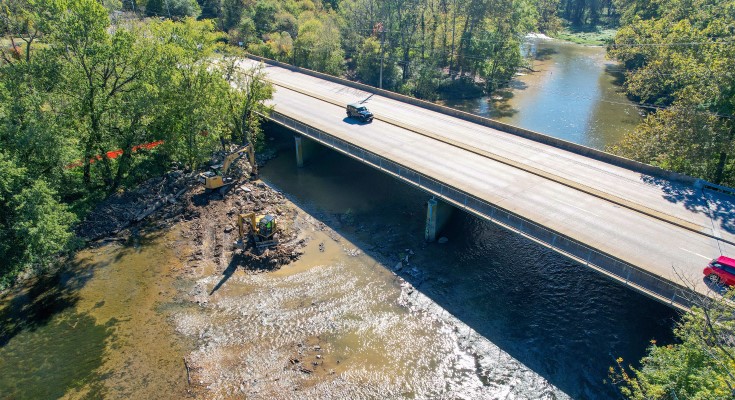
CHADDS FORD, PA — The Brandywine Conservancy removed the century-old Hoffman’s Mill dam from Brandywine Creek on October 6, eliminating a floodwater obstruction near the Route 1 bridge and reopening a section of the waterway to fish migration and recreational use after nearly six years of planning and permitting.
The removal, completed in Chadds Ford and Pennsbury townships, addresses a structure identified in the 2025 Brandywine Flood Study as a potential contributor to flooding in the Chadds Ford area.
The low-head dam had been breached on its western side and no longer served an operational purpose. During high-water events, the remaining structure trapped debris, increasing the obstruction to water flow and potentially worsening flooding upstream.
Its removal was among the flood mitigation measures recommended in the study, which the Conservancy developed with the Chester County Water Resources Authority and the University of Delaware Water Resources Center.
The project also eliminates a physical hazard for kayakers, canoeists and tubers who previously had to carry their equipment around the dam to continue downstream.
For aquatic species, removing the barrier restores a section of creek habitat and improves opportunities for fish to move through the waterway.
The Conservancy identified the project as part of a broader regional effort to restore American shad migration in the Brandywine watershed. Historic dam construction, beginning in Wilmington, Delaware, in the early 1700s, disrupted the species’ traditional spawning routes.
“Freeing this stretch of the Creek benefits our broader mission and some of our ongoing efforts to improve recreational access to the Brandywine, lesson flooding in the Chadds Ford area, and to assist in a regional effort to facilitate the migration of American shad up the Brandywine to spawn,” said Rob Daniels, the Conservancy’s assistant director of community services and project manager.
The dam dated to the late 19th century, when it supplied power to Hoffman’s Mill, a sawmill that operated until the mid-20th century. The mill property is now part of the Brandywine Museum of Art.
The Conservancy began evaluating removal in 2020, concluding that eliminating the deteriorated structure would provide environmental, recreational and potential flood mitigation benefits.
Engineering consultant Ramboll designed the project, coordinated permitting with Conservancy staff and oversaw construction. Stonewood Landshaping carried out the physical removal.
The project was funded by the National Fish and Wildlife Foundation, with support from the U.S. Fish and Wildlife Service, Pennsylvania Department of Conservation and Natural Resources, Chadds Ford Township and Pennsbury Township.
Planning and permitting involved coordination with the Pennsylvania Department of Transportation, PECO and East Penn Railroad because of infrastructure near the dam.
The Conservancy also sought input from local governments, the Chadds Ford Historical Society, the Chester County Planning Commission and the Delaware County Planning Department.
Although the dam has been removed, site cleanup and temporary trail restrictions may continue into mid-October as the remaining work is completed.
The Conservancy documented the historic structure through photographs and video before removal and is evaluating opportunities to reuse materials from the site.
It also plans educational programming examining the dam’s history and its role in the development of the Chadds Ford area.
The completed removal eliminates one of the creek’s longstanding artificial barriers, although the extent of any reduction in future flooding will depend on storm conditions and other factors affecting the Brandywine watershed.
Support the local news that supports Chester County. MyChesCo delivers reliable, fact-based reporting and essential community resources—free for everyone. If you value that, click here to become a patron today.