
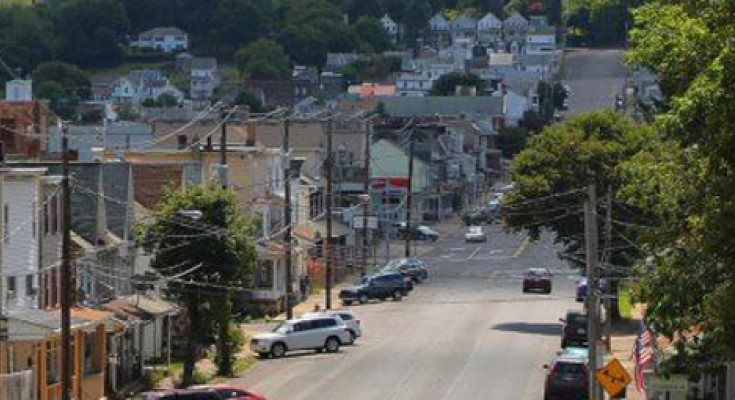
The hills close in quickly around Shamokin. Brick storefronts line Independence Street beneath slopes scarred by more than a century of mining. Church steeples rise above tightly packed blocks. Beyond downtown, old industrial land gives way to ridges, woods and the dark remnants of the anthracite economy that once made this corner of Northumberland County hum with rail traffic, factory whistles and shift changes.
It is not the Pennsylvania of polished resort towns or carefully curated heritage districts.
And that may be precisely why travelers are beginning to notice it.
A new survey commissioned by Hostinger and conducted among 3,000 travelers ranked Shamokin No. 13 nationally among overlooked American towns with untapped tourism potential. The finding arrives as communities across Pennsylvania’s former coal regions search for ways to turn industrial history, outdoor recreation and downtown reinvestment into a new economic identity—without sanding away the rough edges that make them distinctive.
Shamokin has plenty of those edges.
Its story begins beneath the ground.
The city grew on land patented in 1776 and was laid out in 1835, eventually drawing successive waves of English, Welsh, Irish, Italian, Polish, Lithuanian and German immigrants into a community built around anthracite coal.
By the early 20th century, Shamokin and neighboring Coal Township had become one of the region’s largest population and trading centers. Coal mines fed industry. Railroads moved workers and freight. Silk mills, hosiery factories, breweries, bakeries, dairies and movie theaters filled out an economy that extended well beyond the collieries.
At its peak in the 1920s, the combined population of Shamokin and Coal Township reached roughly 50,000.
The physical scale of that era remains visible.
The former J.H. & C.K. Eagle Silk Mill was once described as the largest textile building under one roof in America. The surrounding neighborhoods filled with workers’ houses, churches and businesses serving immigrant families whose languages and traditions became inseparable from the city.
Then came the long contraction.
Coal declined as the country’s energy economy changed. Textile production disappeared. Rail service receded. The Great Depression accelerated the damage, and the population steadily fell.
What remained was a city with far more infrastructure, architecture and history than its modern population might suggest.
That imbalance is part of Shamokin’s present-day appeal.
For travelers accustomed to destinations where every historic building has been converted into a boutique hotel or tasting room, Shamokin offers something less mediated. Its coal-country landscape remains functional, weathered and occasionally imposing. Industrial buildings and older commercial blocks stand beside modest businesses rather than behind velvet ropes.
Hostinger’s survey described that quality as “rawer” than Pennsylvania’s more polished heritage destinations.
It also pointed to downtown revitalization efforts and independent businesses as reasons the city may have more tourism potential than its profile suggests.
History supplies another argument.
Few small Pennsylvania cities can claim a connection to Thomas Edison quite like Shamokin’s.
In 1882, local investors backed the creation of the Edison Electric Illuminating Co. of Shamokin. Edison personally supervised development of the generating system, and the city became the site of one of the world’s earliest three-wire electric light stations.
St. Edward’s Church subsequently became widely recognized as the first church in America illuminated by an Edison electrical system.
For a city built on coal, there is an elegant irony in the episode.
Shamokin helped fuel industrial America with anthracite, then became an early proving ground for the technology that would help transform how Americans worked, worshipped and lived after dark.
The city’s heritage extends into sports, military history and popular culture.
Baseball Hall of Famer Stanley Coveleski came from the area. So did Freeman V. Horner, awarded the Medal of Honor for combat in Germany during World War II.
Shamokin’s name also appeared on a U.S. Navy vessel, and the community produced figures whose careers reached far beyond the coal fields—from naval aviation to architecture and medicine.
Yet some of the most compelling modern tourism potential lies outside the old downtown.
The Anthracite Outdoor Adventure Area has transformed former mining terrain into a destination for off-road riders, using the very landscape created by extraction as the foundation for a new recreation economy.
It is difficult to imagine a more literal reinvention.
Land once cut, hauled and piled for industrial production now attracts visitors because of its roughness. Steep climbs, abandoned haul roads and former mining ground have become features rather than liabilities.
That same tension between damage and preservation defines nearby coal-country scenery.
Massive culm banks remain visible, including the Cameron/Glen Burn landscape associated with one of the area’s most prominent mine-waste piles. For generations, such features symbolized environmental cost and economic decline.
Today, they also tell visitors exactly where they are.
Shamokin does not need to pretend its industrial history happened somewhere else.
The challenge is persuading travelers to stop long enough to understand it.
Hostinger’s research suggests that problem may have less to do with what towns possess than with whether visitors can discover it before they arrive.
Thirty-two percent of respondents reported that a strong local business website had persuaded them within the previous year to stop somewhere they otherwise would have passed.
Poor or missing digital information worked in the opposite direction.
Travelers cited websites without photographs, outdated information, businesses with no website and uncertainty over whether a place was still open as reasons to move on.
“Most of these towns don’t have a character problem, they have a visibility problem,” Gabrielė Račaitytė-Krasauskė, Hostinger’s global public relations lead, stated.
“Travelers decide where to stop long before they arrive, and that decision happens on a phone screen.”
Search engines remain the dominant discovery tool, used by 35% of respondents to find lesser-known destinations. Word of mouth followed at 28%, while social media accounted for 15%.
AI tools such as ChatGPT and Gemini registered 6%.
The economics of getting noticed can be significant for towns like Shamokin.
A traveler stopping for lunch contributes something. A visitor staying overnight contributes substantially more.
When respondents were asked what might convert a drive-through into an overnight visit, 26% pointed to strong reviews and photographs. Another 25% cited a standout hotel, restaurant or shop.
That suggests small cities do not necessarily need dozens of marquee attractions.
Sometimes they need one reason to stop—and enough reliable information online for someone to believe the stop will be worthwhile.
Shamokin already has several possibilities.
There is the Edison history.
The immigrant neighborhoods.
The churches and industrial architecture.
The anthracite landscape.
The outdoor recreation.
And there is Independence Street itself, where the city has spent years wrestling with the same question facing dozens of former industrial communities across Pennsylvania: what comes after the economy that built you disappears?
The answer is unlikely to be tourism alone.
But tourism can alter the way outsiders—and sometimes residents—see a place.
A century ago, people came to Shamokin because the mines, mills and factories offered work. Today, a different kind of visitor may arrive precisely because that world left such a deep imprint.
Toward evening, the steep hills around the city darken first.
Lights begin appearing along Independence Street. The brick facades take on a softer tone, and the old industrial landscape settles into shadow.
The mines are mostly silent now.
The crowds are smaller.
But the city remains, carrying electricity, coal, immigration, industry and reinvention in the same few square miles.
For travelers willing to leave Pennsylvania’s better-known routes, Shamokin’s appeal may lie in exactly that persistence: not a town preserved outside of time, but one still figuring out what to do with everything history left behind.
Support the local news that supports Chester County. MyChesCo delivers reliable, fact-based reporting and essential community resources—free for everyone. If you value that, click here to become a patron today.