
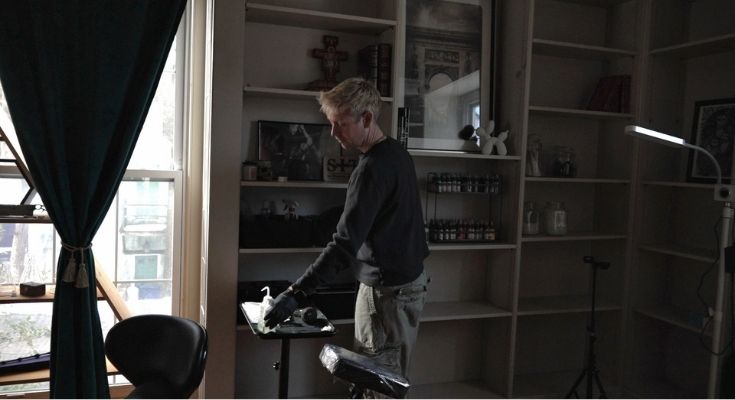
EXTON, PA — Francis Palmquist, a former priest who began tattooing in Mexico after leaving religious life, is building a business at Creatrix Collective in Chester County, applying his classical art training to a career in realistic tattoos while establishing a client base in the Philadelphia region.
Palmquist, who has worked as a tattoo artist for eight years, joined Creatrix Collective in January 2026 after previously working at a tattoo studio on Philadelphia’s South Street.
His transition from the priesthood to tattooing has attracted national attention, including coverage by Religion News Service distributed through The Associated Press. His work in Exton represents a more recent stage of that transition, centered on developing an independent business and refining his artistic techniques.
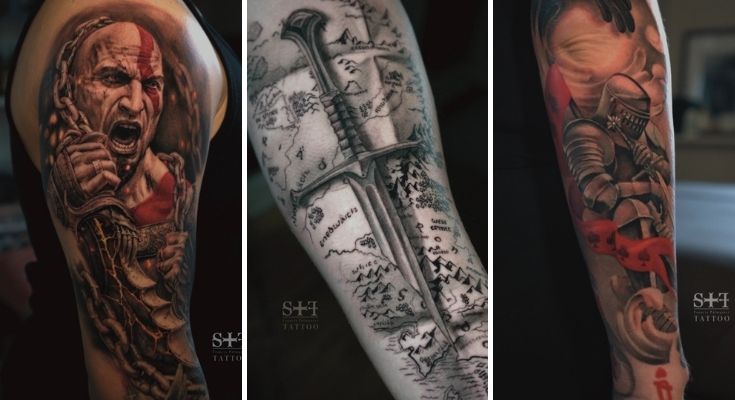
Palmquist specializes in black-and-grey realism and color realism, styles that use detailed shading, tonal variation, and careful reproduction of visual references to create lifelike images.
His artistic foundation predates his tattooing career. As a teenager, he studied classical techniques under a monk who was an accomplished artist, an experience he credits with developing his attention to detail.
“He taught me a lot of classical techniques, and we always used the great masters of the past,” Palmquist said.
That training eventually influenced his work in portraiture, floral designs, and other realistic tattoos.
Palmquist initially concentrated on black-and-grey tattoos but has increasingly pursued color realism over the past year, expanding the range of techniques he uses.
The work requires substantial time and precision, he said, particularly when developing tonal depth and fine details.
Rather than rush through a design, Palmquist said he will end a session if fatigue begins affecting the quality of his work and resume at another appointment.
“For me, treating tattoos like I’m on the factory line seems like the worst possible way to be an artist,” he said.
His path into the industry began in Mexico, where he had originally been stationed as a priest.
After leaving religious life, Palmquist encountered a tattoo artist through a coworker of his first boyfriend and began investigating the profession.
The attraction was both artistic and practical. Tattooing offered an opportunity to pursue a creative career while establishing financial independence.
“I always loved tattoos for the artistic quality, but also the rebellious or counter-cultural aspect as well,” Palmquist said. “They were forbidden in my previous life.”
He spent several years developing his skills in Mexico before returning to the United States.
When considering where to establish himself, Palmquist weighed opportunities in New York City and Philadelphia. Although a New York studio expressed interest in hiring him, the higher cost of living influenced his decision.
He chose Philadelphia, where he also had relatives in South Jersey who could provide support during the transition.
Palmquist initially worked primarily at a South Street tattoo shop but eventually sought another professional environment.
His personal circumstances also influenced the move. As he and his boyfriend considered living together, Palmquist began looking for opportunities closer to Chester County.
The couple now lives in Phoenixville.
Palmquist contacted several studios along the Main Line before joining Creatrix Collective, located at 412 Newcomen Road, Suite 200, in Exton.
The studio occupies a converted library, with an open floor plan and a quieter environment than the walk-in tattoo shops where he previously worked.
Palmquist said the arrangement allows artists to operate their businesses independently while working within a shared studio.
“We have full independence to run our own businesses, which lines up perfectly with how I have always acted as a tattoo artist – depending on myself and myself alone to get the job done,” he said.
That independence has allowed him to concentrate on custom designs and longer appointments rather than relying on walk-in traffic.
His customers include students, parents, grandparents, police officers, firefighters and professionals from a range of industries.
Palmquist said clients generally seek detailed custom work and are willing to invest the time required to complete it.
The relationships formed during those appointments are another important part of his work.
Tattoo sessions can last for hours, creating opportunities for extended conversations between artist and client.
Palmquist sees a connection between those interactions and his former religious vocation, particularly the importance of listening.
“I know that I am a good listener, and I have learned over the years and through my training that listening is much more important than speaking one’s opinions on a particular matter,” he said.
He said he tries to create an environment where clients feel comfortable discussing their experiences, even when those conversations extend beyond the tattoo itself.
The personal dimension of his career has also shaped how Palmquist views the attention surrounding his departure from the priesthood.
An openly gay man, Palmquist recognizes that his transition between two seemingly unrelated professions has become the defining element of much of the coverage about him.
He considers that framing incomplete.
“Gay, ex priest, tattoo artist,” he said, describing the labels frequently associated with his story. “Ultimately, my story is simply ‘me.'”
Palmquist said he does not want his professional identity reduced to his past religious role or personal circumstances.
Instead, he hopes his experience demonstrates that people can establish new careers and personal lives after leaving institutions or circumstances that once defined them.
His perspective on personal responsibility has also changed.
“No One is watching my every action and thought, as God did before, but what matters is that I am looking at myself,” he said. “Am I living according to who I am or the values that I claim to hold? I am accountable to myself.”
For Palmquist, the immediate priority is continuing to develop his tattoo business in Chester County.
He said he is satisfied with the local market and the gradual recognition his work is receiving, without seeking celebrity status or restricting his services to wealthy clients.
“I want good quality tattoos accessible to anyone,” he said.
He continues to take courses, practice drawing and develop his technical abilities, particularly in color realism.
Palmquist said his current circumstances already represent a substantial achievement compared with the uncertainty he faced when leaving religious life.
“The fact that I am able to have this career, have a boyfriend – that I am able to not only survive, but thrive in this new chapter of my life, is already a success,” he said.
Palmquist’s tattoo portfolio and additional information about his work are available at https://stfrancistattoo.com and https://www.instagram.com/st.francis.tattoo/.
Support the local news that supports Chester County. MyChesCo delivers reliable, fact-based reporting and essential community resources—free for everyone. If you value that, click here to become a patron today.